
Mathematical part of the research report Fundamental gap δ property, Thomas Giarrizzi, supervised by Guofang Wei, University of California, Santa Barbara. The account of the internship has been omitted. The mathematical text and its original numbering are retained below.
0. Backgrounds and Notation
Throughout this paper, a pair \((M^n,g)\) will denote a Riemannian manifold; that is, an \(n\)-dimensional smooth manifold \(M^n\) with a Riemannian metric \(g\), i.e., a smooth symmetric positive definite \((0,2)\)-tensor field on \(M^n\). We will assume that \(M^n\) is connected. The metric \(g\) induces an inner product
\[g_p:(X,Y)\in T_pM\times T_pM\longmapsto g_p(X,Y)\in\mathbb R.\]The Levi-Civita connection \(\nabla\) on \((M^n,g)\) is the unique torsion-free affine connection that is compatible with the metric, meaning that \(\nabla g=0\). For vector fields \(X,Y,Z\) on \(M^n\), it satisfies
\[Xg(Y,Z)=g(\nabla_XY,Z)+g(Y,\nabla_XZ).\]The Riemannian distance \(d_g(p,q)\) between two points \(p,q\in M^n\) is defined as the infimum of the lengths of piecewise smooth curves connecting \(p\) and \(q\), where the length of a curve \(\gamma:[a,b]\to M^n\) is
\[\ell(\gamma)=\int_a^b\sqrt{g_{\gamma(t)}(\dot\gamma(t),\dot\gamma(t))}\,dt.\]A geodesic is a curve \(\gamma\) that locally minimizes the distance, satisfying the geodesic equation \(\nabla_{\dot\gamma}\dot\gamma=0\). A geodesic is minimizing if it achieves the infimum distance between its endpoints.
A subset \(\Omega\subset M^n\) is convex if for any two points \(x,y\in\Omega\), any minimizing geodesic between \(x\) and \(y\) lies in \(\Omega\).
The volume form associated to \(g\) is denoted by \(d\mathrm{Vol}_g\) or \(dV_g\), which in local coordinates \((x^1,\ldots,x^n)\) is
\[d\mathrm{Vol}_g(x)=\sqrt{\det(g_{ij})}\,dx^1\wedge\cdots\wedge dx^n, \qquad g_{ij}=g(\partial/\partial x^i,\partial/\partial x^j).\]The gradient of a smooth function \(f:M^n\to\mathbb R\) is the vector field \(\nabla_gf\) defined by \(g(\nabla_gf,X)=df(X)\) for any vector field \(X\).
The Laplacian (or Laplace-Beltrami operator) \(\Delta_g\) acting on smooth functions \(f\) is defined as \(\Delta_gf=\operatorname{div}_g(\nabla_gf)\), where the divergence of a vector field \(X\) is \(\operatorname{div}_gX=\operatorname{trace}_g(\nabla X)\).
The Ricci curvature \(\mathrm{Ric}_g\) is the \((0,2)\)-tensor defined by
\[\mathrm{Ric}_g(X,Y)=\operatorname{trace}_g\bigl(Z\mapsto R(Z,X)Y\bigr),\]where \(R\) is the Riemann curvature tensor given by
\[R(X,Y)Z=\nabla_X\nabla_YZ-\nabla_Y\nabla_XZ-\nabla_{[X,Y]}Z.\]The sectional curvature (denoted \(\mathrm{sec}_g\)) in the plane spanned by orthonormal vectors \(X,Y\) is \(g(R(X,Y)Y,X)\).
1. Introduction
Given a bounded smooth domain \(\Omega\subset M^n\) of a Riemannian manifold, the eigenvalue equation of the Laplacian on \(\Omega\) is \(\Delta u=-\lambda u\). We may impose boundary conditions, which will be the subject of further discussion:
\[\begin{array}{c@{\qquad\qquad}c} \text{Dirichlet conditions}&\text{Neumann conditions}\\ \Delta u=-\lambda u\quad\text{in }\Omega&\Delta v=-\mu v\quad\text{in }\Omega\\ u=0\quad\text{on }\partial\Omega&\partial_nv=0\quad\text{on }\partial\Omega. \end{array}\]Thanks to classical results on compact self-adjoint operators, the eigenvalues consist of an infinite sequence going off to infinity:
\[\begin{aligned} \text{Dirichlet }(u|_{\partial\Omega}=0):&\quad 0<\lambda_1<\lambda_2\leq\lambda_3\leq\cdots\to\infty,\\ \text{Neumann }(\partial_nv|_{\partial\Omega}=0)\text{ / closed manifolds}:&\quad 0=\mu_0<\mu_1\leq\mu_2\leq\cdots\to\infty. \end{aligned}\]We have the min-max principle to characterize each eigenvalue
\[\lambda_k(\Omega)=\min_{\substack{V\subset H^1_0(\Omega)\\\dim V=k}}\max_{\substack{f\in V\\f\ne0}}R_g[f], \qquad \mu_k(\Omega)=\min_{\substack{V\subset H^1(\Omega)\\\dim V=k+1}}\max_{\substack{f\in V\setminus\{0\}\\\int_\Omega f=0}}R_g[f],\]with the Rayleigh quotient
\[R_g[f]=\frac{\int_\Omega\|\nabla_gf\|_g^2\,dV_g}{\int_\Omega f^2\,dV_g}.\]Due to the characterization above, we have the decreasing monotonicity of Dirichlet eigenvalues under domain inclusion, i.e., for two domains \(\Omega_1\) and \(\Omega_2\), if \(\Omega_1\subset\Omega_2\), then \(\lambda_k(\Omega_1)\geq\lambda_k(\Omega_2)\). One of the central problems is to estimate the so-called fundamental gap, i.e., the quantity \(\lambda_2(\Omega)-\lambda_1(\Omega)\). Since except for some very specific domains (such as Euclidean balls, rectangles and triangles, spherical triangles and lunes, etc.), it is extremely difficult to compute the eigenvalues explicitly, we need to provide some optimal geometric lower and upper bounds of the gap.
This subject has a long story, and most available results are established in the Euclidean setting. For example, in Euclidean space, there was a conjecture stated by M. van den Berg in 1983 after some observations on some particular cases, saying that for each convex domain \(\Omega\subset\mathbb R^n\), one has
\[\lambda_2(\Omega)-\lambda_1(\Omega)\geq\frac{3\pi^2}{D(\Omega)^2},\]where \(D(\Omega)\) represents the diameter of the domain \(\Omega\). The bound \(\pi^2/(4D(\Omega)^2)\) was firstly found by Singer-Wong-Yau-Yau in [6], followed by the bound \(\pi^2/D(\Omega)^2\) found by Yu-Zhong [7], Ling [8]. Finally, in 2011, the Fundamental Gap Conjecture was resolved by Andrews-Clutterbuck [9], and the bound \(3\pi^2/D(\Omega)^2\) is optimal and is approached when the domain is a thin rectangular box. This is the subject of part 2.
This suggests a study of the same type of bound for other spaces and, in particular, for spaces with constant sectional curvature. For the round sphere \(S^n\), we can obtain the same bound as in the Euclidean space for \(n\geq2\), \(D(\Omega)<\pi\). For the hyperbolic space \(\mathbb H^n\) (and more generally for spaces with curvature not everywhere positive \(\geq0\)), the behavior is completely different; the gap can be made arbitrarily small, and thus there exist no strict positive lower bounds in those spaces. More precisely, we have the following result.
Theorem 1.1 (G. Khan and X. H. Nguyen, 2024, [11]). Let \((M^n,g)\) be a smooth Riemannian manifold. Suppose that there is a point \(p\) and a tangent plane \(V\) at \(p\) satisfying \(\kappa(V)<0\), where \(\kappa\) is the sectional curvature. Then, for all \(\varepsilon>0\), there is a domain \(\Omega\) which is geodesically convex and such that
\[\lambda_2(\Omega)-\lambda_1(\Omega)\leq\frac{\varepsilon}{D^2},\]where \(D\) is the diameter of \(\Omega\).
We can thus introduce the following definition:
Definition 1.2 (\(\Gamma_\delta\) property). A space \(M\) satisfies the fundamental gap \(\delta\) (denoted \(\Gamma_\delta\), with \(\delta>0\)) property if for all convex domains \(\Omega\), the following estimate holds:
\[\lambda_2(\Omega)-\lambda_1(\Omega)\geq\frac{\delta\pi^2}{D(\Omega)^2},\]where \(D(\Omega)\) is the diameter of \(\Omega\).
In other words, a space satisfies \(\Gamma_\delta\) if the following inequality holds:
\[\inf_{\Omega\subset M\text{ convex}}\bigl(\lambda_2(\Omega)-\lambda_1(\Omega)\bigr)D(\Omega)^2\geq\delta\pi^2.\]This property has been introduced in [4]. It may be interesting to see what the constant \(\delta\) depends on. Actually, for a fixed domain, eigenvalues and eigenfunctions depend on the metric in a continuous way (in a smooth enough topology), so it may be tempting to conclude that since the round sphere satisfies \(\Gamma_3\), a nearly-round sphere automatically satisfies \(\Gamma_1\), simply by continuity. But as explained in [4], where the \(\Gamma_\delta\) property has been introduced, we can deform the Euclidean space in \(C^\infty\) fashion to a metric with some negative sectional curvature, which thus does not satisfy the \(\Gamma_\delta\) property for any \(\delta>0\). So the constant \(\delta\) does not depend on the metric in a continuous way. We can also already deduce that the \(\Gamma_\delta\) property gives automatically \(\mathrm{Ric}\geq0\). In the same paper, the authors posed two questions that motivated further investigation on my part:
Question 1. Under what conditions is the \(\Gamma_\delta\) condition deformation stable, and in what topology? For instance, do sufficiently \(C^2\)-small deformations of a round sphere satisfy \(\Gamma_{2.99}\)?
Question 2. Let \((M_i,g_i)\) be a sequence of Riemannian manifolds which all satisfy \(\Gamma_\delta\) and converge to an Alexandrov space \(M_\infty\). Does \((M_\infty,g_\infty)\) also satisfy \(\Gamma_\delta\)?
In this paper, for question 2, we give a partial answer (or rather a weaker result), by adding two more properties for each \(M_i\) to make possible the stability of \(\Gamma_\delta\); this is the subject of section 3. For question 1, it is more complicated; we can try to generalize the question: can we find some conditions on manifolds to make the constant \(\delta\) lower-semicontinuous with respect to a certain topology?
And honestly, let us say it right away: the result is rather disappointing. The conditions we found are purely abstract, and it is not even clear whether such spaces actually exist — all the more so since the proof remains quite elementary given the nature of the conditions; this is the subject of section 4. Let us begin, in the next section, with a brief survey of the powerful results on the fundamental gap in Euclidean space and on the sphere.
2. Fundamental gap of the Euclidean space and the round sphere
The Euclidean space and the round sphere satisfy both \(\Gamma_3\). And the techniques used to achieve the result are similar: using modulus of continuity, establishing the super log-concavity of the first eigenfunction and using two-point maximal principle. In this part, we provide a brief summary of the proof for the Euclidean case, from Andrews-Clutterbuck [9], outlining only the essential arguments. The conjecture is generalized and solved for the operator \(\Delta+V\), with a convex function \(V\). Let us denote \(\phi_1\) (resp. \(\widetilde\phi_1\)) the first eigenfunction of the operator \(-\Delta+V\) (resp. the one-dimensional operator \(-d^2/dx^2+\widetilde V\) on the interval \([-D(\Omega)/2,D(\Omega)/2]\)).
2.1. Modulus of continuity/expansion
In the first article, the authors introduce a few more relevant notions in a general context. Here we say that a function \(\omega\) on \(\mathbb R_+\) is
- a modulus of continuity of a function \(f\) on \(\Omega\) if for all \(x,y\in\Omega\), \[|f(x)-f(y)|\leq2\omega\!\left(\frac{|y-x|}{2}\right);\]
- a modulus of expansion of a vector field \(X\) if for all \(x\ne y\in\Omega\), \[\bigl(X(y)-X(x)\bigr)\cdot\frac{y-x}{|y-x|}\geq2\omega\!\left(\frac{|y-x|}{2}\right);\]
- a modulus of contraction of a vector field \(X\) if \(-\omega\) is a modulus of expansion of \(-X\);
- a modulus of convexity (resp. modulus of concavity) of a semi-convex function \(f:\Omega\to\mathbb R\) if \(\omega\) is a modulus of expansion (resp. contraction) of the gradient vector field \(\nabla f\).
Actually, moduli of concavity/convexity are very useful to “compare” the convexity and the concavity of two functions and even to compare the spectrum of two operators. In a sense, we can say that the potential \(V\) is “more convex” than \(\widetilde V\) if \(\widetilde V\) is a modulus of convexity for \(V\), i.e., for any \(x\ne y\in\Omega\) we have
\[\bigl(\nabla V(y)-\nabla V(x)\bigr)\cdot\frac{y-x}{|y-x|}\geq2\widetilde V\!\left(\frac{|y-x|}{2}\right).\tag{1}\]One of the most technical results is to show that inequality (1) implies a (super) log-concavity estimate for the first eigenfunction \(\phi_1\):
\[\bigl(\nabla\ln\phi_1(y)-\nabla\ln\phi_1(x)\bigr)\cdot\frac{y-x}{|y-x|} \leq2(\ln\widetilde\phi_1)'\big|_{z=|y-x|/2}.\tag{2}\]For any \(x\ne y\in\Omega\), and thus, in a sense, \(\phi_1\) is “more log-concave” than \(\widetilde\phi_1\). Due to the length request of this paper, we cannot even give a summary of the proof of (2) without forgetting something important. We can give instead the proof that inequality (2) solves the conjecture. Indeed, we will show that the spectral gap for \(-\Delta+V\) is bounded below by the spectral gap of the one-dimensional operator \(-d^2/dx^2+\widetilde V\). In other words, if \(\widetilde\lambda_i\) is the eigenvalue associated to \(\widetilde\phi_i\), then
\[\lambda_2(\Omega)-\lambda_1(\Omega)\geq\widetilde\lambda_2-\widetilde\lambda_1.\tag{3}\]And since the conjecture is already settled for \(n=1\) (thanks to Lavine), we can thus deduce the result for \(n\geq2\).
2.2. Spectrum comparison
Proof of inequality (2) ⇒ inequality (3). Let us start the proof by giving a very useful theorem (see [9]):
Theorem 2.1. Let \(\Omega\) be a strictly convex domain of diameter \(D\) with smooth boundary in \(\mathbb R^n\), and \(X\) a time-dependent vector field on \(\Omega\). Suppose \(v:\Omega\times\mathbb R_+\to\mathbb R\) is a smooth solution of the equation
\[\begin{cases}\partial_tv=\Delta v+X\cdot\nabla v&\text{in }\Omega\times\mathbb R_+,\\D_\nu v=0&\text{on }\partial\Omega\times\mathbb R_+.\end{cases}\tag{4}\]Suppose that:
- \(X(\cdot,t)\) has modulus of contraction \(\omega(\cdot,t)\) for each \(t\geq0\), where \(\omega:[0,D/2]\times\mathbb R_+\to\mathbb R\) is smooth;
- \(v(\cdot,0)\) has modulus of continuity \(\varphi_0\), where \(\varphi_0:[0,D/2]\to\mathbb R\) is smooth with \(\varphi_0(0)=0\) and \(\varphi_0'(z)>0\) for \(0\leq z\leq D/2\);
- \(\varphi:[0,D/2]\times\mathbb R_+\to\mathbb R\) satisfies \[\begin{aligned} \text{(a)}\;&\varphi(z,0)=\varphi_0(z) &&(z\in[0,D/2]),\\ \text{(b)}\;&\partial_t\varphi\geq\varphi''+\omega\varphi'&&\text{on }[0,D/2]\times\mathbb R_+,\\ \text{(c)}\;&\varphi'>0&&\text{on }[0,D/2]\times\mathbb R_+,\\ \text{(d)}\;&\varphi(0,t)\geq0&&(t\geq0). \end{aligned}\]
Then \(\varphi(\cdot,t)\) is a modulus of continuity for \(v(\cdot,t)\) for each \(t\geq0\).
Let \(u_1\) and \(u_0\) be two smooth solutions to the parabolic Schrödinger equation
\[\begin{cases}\partial_tu=\Delta u-Vu&\text{on }\Omega\times\mathbb R_+,\\u=0&\text{on }\partial\Omega\times\mathbb R_+,\end{cases}\tag{5}\]on a bounded strictly convex domain \(\Omega\) with smooth boundary in \(\mathbb R^n\), with \(u_1\) positive on the interior of \(\Omega\). Let \(v(x,t)=u_2(x,t)/u_1(x,t)\). Both \(u_1\) and \(u_2\) are smooth on \(\overline\Omega\times[0,\infty)\), and \(u_1\) has negative derivative in the normal direction \(\nu\). It follows that \(v\) extends to \(\overline\Omega\) as a smooth function. By computing directly,
\[\begin{aligned}\partial_tv&=\partial_t\!\left(\frac{u_2}{u_1}\right)\\ &=\frac{\Delta u_2-Vu_2-v(\Delta u_1-Vu_1)}{u_1}\\ &=\Delta v+2\nabla\log u_1\cdot\nabla v.\end{aligned}\tag{6}\]Moreover, at any point in \(\partial\Omega\) we have \(\partial_tv\) and \(\Delta v\) bounded, \(\nabla u_1=-c\nu\) with \(c>0\), and \(u_1=0\), so it follows from (6) that \(D_\nu v=0\), and then \(v\) satisfies (4) with \(X=2\nabla\log u_1\).
Now, the goal is to use Theorem 2.1 with \(\varphi=C e^{-\mu_1t}\widetilde\phi_2/(e^{-\mu_1t}\widetilde\phi_1)\). Firstly, thanks to inequality (2), \(X=2\nabla\log u_1\) has modulus of contraction \(\omega=2(\ln\widetilde\phi_1)'\) (condition 1 of Theorem 2.1). Secondly, condition 2 holds for sufficiently large \(C\), since \(v(\cdot,0)\) is smooth and so has a bounded gradient and satisfies \(|v(y,0)-v(x,0)|\leq K|y-x|\) for some large \(K\), while \(\widetilde\phi_2/\widetilde\phi_1\) is positive on \((0,D(\Omega)/2)\) and has a positive gradient at \(z=0\), so it is bounded below by \(cz\) for small \(c>0\). Thirdly, conditions 3(i)–(iv) also hold, except that \(\varphi'(D(\Omega)/2)=0\) and \(\omega\) is not smooth at \(D(\Omega)/2\) since \(\widetilde\phi_1\) vanishes at this point. We handle these complications below by making slight adjustments to \(\varphi\) and \(\omega\).
For small \(\varepsilon>0\) we construct a smooth function \(\omega_\varepsilon\geq\omega\) and corresponding functions \(\varphi_{\varepsilon,\widetilde\varepsilon}\) as follows. We first replace the Dirichlet eigenfunction \(\widetilde\phi_1\) by a Robin eigenfunction \(\widetilde\phi_{1,\varepsilon}\) with eigenvalue \(\widetilde\lambda_{1,\varepsilon}<\widetilde\lambda_1\) defined by
\[\begin{cases} \widetilde\phi_{1,\widetilde\varepsilon}''-\widetilde V\widetilde\phi_{1,\widetilde\varepsilon}+\widetilde\lambda_{1,\varepsilon}\widetilde\phi_{1,\widetilde\varepsilon}=0&\text{on }[0,D/2],\\ \widetilde\phi_{1,\widetilde\varepsilon}(D/2)=\widetilde\varepsilon,\quad\widetilde\phi_{1,\widetilde\varepsilon}'(D/2)=-1,\\ \widetilde\phi_{1,\widetilde\varepsilon}'(0)=0,\quad\widetilde\phi_{1,\widetilde\varepsilon}>0&\text{on }[0,D/2]. \end{cases}\tag{7}\]We also replace \(\widetilde\phi_2\) by \(\widetilde\phi_{2,\widetilde\varepsilon}\) with eigenvalue \(\widetilde\lambda_{2,\varepsilon}\) defined by
\[\begin{cases} \widetilde\phi_{2,\widetilde\varepsilon}''-\widetilde V\widetilde\phi_{2,\widetilde\varepsilon}+\widetilde\lambda_{2,\varepsilon}\widetilde\phi_{2,\widetilde\varepsilon}=0&\text{on }[0,D/2],\\ \widetilde\phi_{2,\widetilde\varepsilon}(D/2)=\widetilde\varepsilon,\quad\widetilde\phi_{2,\widetilde\varepsilon}'(D/2)=-1,\\ \widetilde\phi_{2,\widetilde\varepsilon}'(0)=0,\quad\widetilde\phi_{2,\widetilde\varepsilon}>0&\text{on }[0,D/2]. \end{cases}\tag{8}\]For any \(\widetilde\varepsilon>\varepsilon>0\), by posing
\[\varphi_{\varepsilon,\widetilde\varepsilon} =\frac{e^{-\widetilde\lambda_{2,\varepsilon}t}\phi_{2,\varepsilon}}{e^{-\widetilde\lambda_{1,\varepsilon}t}\phi_{1,\varepsilon}}, \qquad\omega_\varepsilon=2(\ln\widetilde\phi_{1,\varepsilon})',\]one can show that \(\omega_\varepsilon\) is smooth, is a modulus of contraction of \(X\) (since \(\omega_\varepsilon\geq\omega\)), and \(C\varphi_{\varepsilon,\widetilde\varepsilon}(\cdot,t)\) is a modulus of continuity for \(v\) for \(t>0\) if it is so at \(t=0\). Now, since \(\varphi_{\varepsilon,\widetilde\varepsilon}\) converges uniformly to \(\varphi\) when \(\widetilde\varepsilon\to\varepsilon\to0\), the same conclusion holds for \(\varphi\). In particular, for sufficiently large \(C\) we have
\[\operatorname{osc}v(\cdot,t)\leq2C\sup\{\varphi(z,t):z\in[0,D/2]\}=2Ce^{-(\mu_1-\mu_0)t}.\]Applying this with \(u_1=\phi_1e^{-\lambda_1t}\) gives \(v=e^{-(\lambda_1-\lambda_0)t}\phi_1/\phi_0\), and hence
\[e^{-(\lambda_1-\lambda_0)t}\operatorname{osc}\frac{\phi_1}{\phi_0}\leq2Ce^{-(\mu_1-\mu_0)t}\]for all \(t\geq0\), which implies \(\lambda_2(\Omega)-\lambda_1(\Omega)\geq\widetilde\lambda_2-\widetilde\lambda_1\). ∎
Remark.
As said before, for the sphere, the same method is used; inequality (1) becomes
\[\left\langle\nabla V(y),\gamma'\!\left(\frac d2\right)\right\rangle- \left\langle\nabla V(x),\gamma'\!\left(-\frac d2\right)\right\rangle \leq2\widetilde V'\!\left(\frac{d(x,y)}2\right),\]where \(\gamma:[-d/2,d/2]\) represents the unique unit-speed length minimizing geodesic connecting \(x\) to \(y\). On the other hand, the super log-concavity estimate (2) becomes
\[\begin{aligned} \left\langle\nabla\log\phi_1(y),\gamma'\!\left(\frac d2\right)\right\rangle -\left\langle\nabla\log\phi_1(x),\gamma'\!\left(-\frac d2\right)\right\rangle \leq-2\frac\pi D\tan\!\left(\frac{\pi d}{2D}\right)+(n-1)\tan\!\left(\frac d2\right). \end{aligned}\]One should emphasize that the super log-concavity estimate was necessary to obtain such a result, and it is substantially stronger than the log-concavity estimate that is typically used: a bound on \(\mathrm{Hess}(\log u_1)\). Indeed, let us assume that \(\mathrm{Hess}(\log u_1)\leq-C\) for a constant \(C\in\mathbb R_+\). By posing \(\omega=u_2/u_1\), where \(u_1,u_2\) are the first and second eigenfunctions of the Laplacian on \(\Omega\), then
\[\Delta\omega+2\langle\nabla\log u_1,\nabla\omega\rangle=-(\lambda_2(\Omega)-\lambda_1(\Omega)),\]with Neumann boundary condition on \(\partial\Omega\). By considering \(S^n\) with weighted measure \(u_1^2\,d\mathrm{vol}=e^{-(-2\log u_1)}d\mathrm{vol}\), the Bakry-Emery Ricci curvature of this metric-measure space is \(n-1-2\mathrm{Hess}(\log u_1)\geq n-1+2C\). Thanks to [13] and [14], the first nonzero Neumann eigenvalue of a weighted Laplacian is \(\geq\pi^2/D(\Omega)^2+L/2\), with \(L\) a lower bound of the Bakry-Emery Ricci curvature. Then we deduce that
\[\lambda_2(\Omega)-\lambda_1(\Omega)\geq\frac{\pi^2}{D(\Omega)^2}+\frac{n-1}2+C.\]Moreover, one can show that the super log-concavity estimate gives in particular the following inequality [12]:
\[\mathrm{Hess}(\log u_1)\leq-\left(\frac{\pi^2}{D(\Omega)^2}-\frac{n-1}2K\right).\]
3. Stability of \(\Gamma_\delta\) under Gromov-Hausdorff convergence
3.1. Gromov-Hausdorff convergence
Let us first investigate the weak and popular notion of Gromov-Hausdorff convergence. By definition, a family of compact metric spaces \((X_k,d_k)_{k\in\mathbb N}\) converges to some metric space \((X,d)\) in the Gromov-Hausdorff sense if there are (Borel measurable) maps \(f_k:X_k\to X\), called approximate isometries, such that
\[\begin{aligned} &\forall x,y\in X_k,&&|d(f_k(x),f_k(y))-d_k(x,y)|\leq\varepsilon_k,\\ &\forall y\in X,\ \exists x\in X_k,&&d(f_k(x),y)\leq\varepsilon_k, \end{aligned}\]where \((\varepsilon_k)_{k\in\mathbb N}\) is a sequence converging to zero. Moreover, if \(X_k\) (resp. \(X\)) is equipped with reference Borel measures \(\mu_k\) (resp. \(\mu\)), we say that \((X_k,d_k,\mu_k)_{k\in\mathbb N}\) converges to \((X,d,\mu)\) in the measured Gromov-Hausdorff sense if \((f_k)_\#\mu_k\) converges in the weak topology to \(\mu\).
Note that there is no reason for \(f_k\) to be continuous maps. Nevertheless, one can still construct approximate inverses \(f_k':X\to X_k\) such that \(d(f_k\circ f_k'(y),y)\leq\varepsilon_k\) and \(d_k(f_k'\circ f_k(x),x)\leq2\varepsilon_k\), for all \((x,y)\in X_k\times X\) (see [5, section 1]). Since the Gromov-Hausdorff convergence takes care only about the distance, a direct implication of this convergence is this small and very useful lemma:
Lemma 3.1. Let \(\gamma_k\) be a minimizing geodesic in \(X_k\) for each \(k\). Then, up to extraction, \(f_k\circ\gamma_k\) converges (uniformly) to a minimizing geodesic in \(X\).
Proof. Analogous proof in [3, Lemma 3.2].
Although this notion does not preserve the local structure, some geometric properties are stable under this convergence. For example, when \(X_k=M_k\) (\(X=M\)) is a Riemannian manifold and all sectional curvatures of \((M_k,g_k)\) are bounded from below by a fixed number \(K\in\mathbb R\), then also the sectional curvatures of \((M,g)\) are bounded from below by \(K\). As mentioned before, in [4, section 4], one of the questions asked is whether the \(\Gamma_\delta\) property is stable under this convergence of Riemannian manifolds. In this section, we prove a weaker version of the result, when each \((M_k,g_k)\) satisfies two additional properties, which we define shortly. Let us first talk about the convex hull of a subset.
About the convex hull. Let \(Q\) be a subset of a Riemannian manifold \(M\). The convex hull of a set \(Q\subset M\) is the minimal convex subset of \(M\) that contains \(Q\). Set \(\mathcal C^0(Q)=Q\) and let inductively \(\mathcal C^{i+1}(Q)\) be the union of all minimizing geodesics between pairs of points of \(\mathcal C^i(Q)\). By definition, the increasing countable union \(\mathcal C(Q)=\bigcup_i\mathcal C^i(Q)\) is the convex hull of \(Q\). Note that if \(M\) is complete and \(Q\) is compact, then each \(\mathcal C^i(Q)\) is compact. In the Euclidean space \(M=\mathbb R^n\) (as well as in the round sphere), one can show that \(\mathcal C(Q)=\mathcal C^n(Q)\). We are now ready to define two relevant properties that contribute to the stability of the \(\Gamma_\delta\) property.
3.2. Caratheodory and GCE Properties
Definition 3.2. A manifold \((M^n,g)\) is said to satisfy the Caratheodory property if for each subset \(Q\subset M^n\), we have \(\mathcal C(Q)=\mathcal C^n(Q)\).
Definition 3.3. A manifold \((M,g)\) is said to satisfy the GCE property (geodesic control from endpoints) if there exists a constant \(C>0\) such that, for any two minimizing geodesics (with constant speed) \(\gamma_1,\gamma_2:I\to M\),
\[d(\gamma_1(t),\gamma_2(t))\leq C\max\{d(\gamma_1(0),\gamma_2(0)),d(\gamma_1(1),\gamma_2(1))\}\]for all \(t\in I\).
Remark. In particular, such a space requires the uniqueness of the minimizing geodesics.
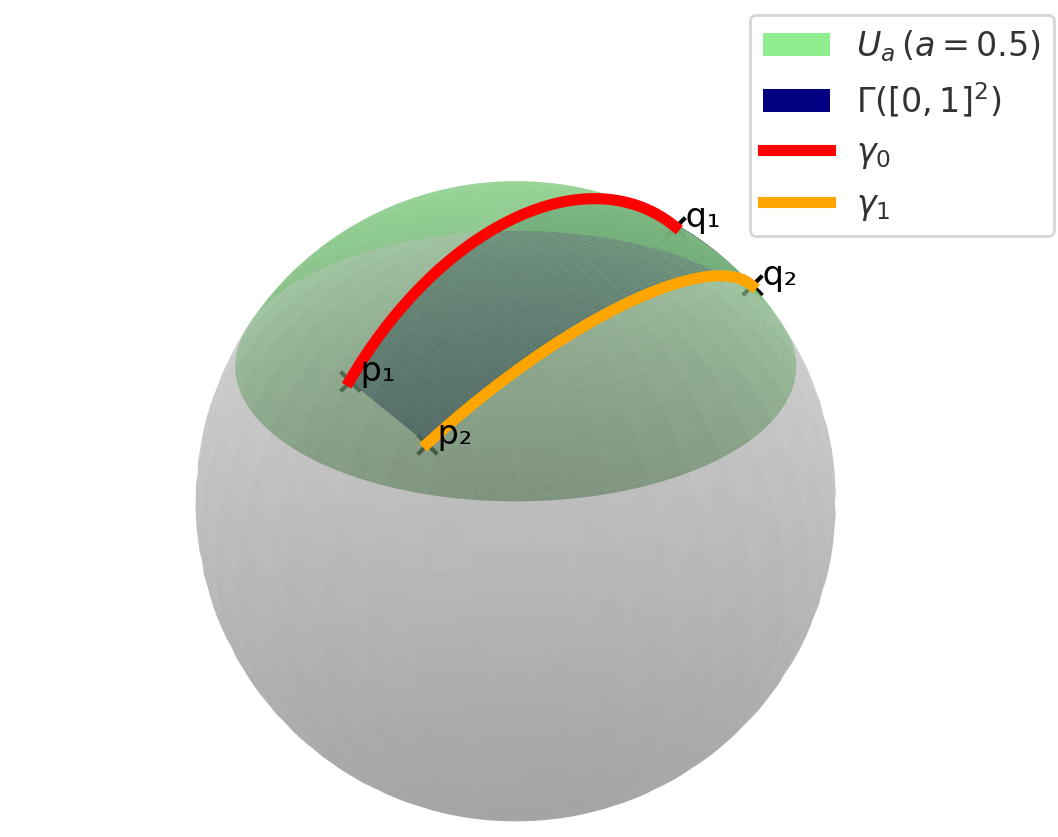
Example (\(U_a=\{(x,y,z)\in S^2:z>a\}\)). For two points \(p,q\in S^2\) such that \(p\ne-q\), the minimizing (with constant speed) geodesic between \(p\) and \(q\) is of the form
\[\gamma_{p,q}(t)=\frac{\sin((1-t)\theta)}{\sin\theta}\,p+\frac{\sin(t\theta)}{\sin\theta}\,q,\qquad t\in[0,1],\]with \(\theta=\arccos\langle p,q\rangle\). By an easy computation we have
\[\begin{cases} \dot\gamma_{p,q}(t)=-\dfrac{\theta\cos((1-t)\theta)}{\sin\theta}\,p+\dfrac{\theta\cos(t\theta)}{\sin\theta}\,q,\\ \ddot\gamma_{p,q}(t)=-\theta^2\gamma_{p,q}(t). \end{cases}\]Let \(U_a=\{(x,y,z)\in S^2:z>a\}\) (with \(a\in(0,1)\)). Note that \(U_a\) is a convex domain of \(S^2\). Now, let \(\gamma_0,\gamma_1:[0,1]\to U_a\) be two minimizing geodesics, and let us take \(\alpha\) (resp. \(\beta\)) the minimizing geodesic joining the points \(\gamma_0(0)\) and \(\gamma_1(0)\) (resp. \(\gamma_0(1)\) and \(\gamma_1(1)\)). Thus by setting \(\theta_s=\arccos\langle\alpha(s),\beta(s)\rangle\), we define the following smooth function
\[\Gamma(s,t)=\frac{\sin((1-t)\theta_s)}{\sin\theta_s}\,\alpha(s)+\frac{\sin(t\theta_s)}{\sin\theta_s}\,\beta(s),\]which satisfies the following properties:
- \(\Gamma(0,\cdot)=\gamma_0,\ \Gamma(1,\cdot)=\gamma_1\);
- \(\Gamma(\cdot,0)=\alpha,\ \Gamma(\cdot,1)=\beta\);
- for all \(s\in[0,1]\), \(t\mapsto\Gamma(s,t)\) is the minimizing geodesic joining \(\alpha(s)\) and \(\beta(s)\).
By construction, along each geodesic \(\gamma_s:=\Gamma(s,\cdot)\), the vector field \(J_s:=\partial_s\Gamma(s,\cdot)\) is a Jacobi field:
\[\frac{D^2}{dt^2}J_s(t)+R(J_s(t),\dot\gamma_s(t))\dot\gamma_s(t)=0.\]By posing \(f_s(t)=\|J_s(t)\|^2+\|\partial_tJ_s(t)\|^2\), we can easily check that \(\partial_tf_s\leq2f_s\) (\(\partial_tf_s\leq(1+C)f_s\) in general if \(|\mathrm{sec}|\leq C\)) and thus have the estimate \(\|J_s(t)\|\leq f_s(t)\leq f_s(0)e^{2t}=\|J_s(0)+\partial_tJ_s(0)\|e^{2t}\). Thanks to elementary estimates, we can explicitly give an upper bound in terms of \(d(\gamma_0(0),\gamma_1(0))\) and \(d(\gamma_0(1),\gamma_1(1))\):
\[\|J_s(0)+\partial_tJ_s(0)\|e^{2t}\leq C(a)\bigl[d(\gamma_0(0),\gamma_1(0))+d(\gamma_0(1),\gamma_1(1))\bigr],\]with a constant \(C(a)\) approaching \(+\infty\) as \(a\to0\). Finally, we deduce for \(t\in[0,1]\),
\[\begin{aligned} d(\gamma_0(t),\gamma_1(t))&\leq\operatorname{length}(s\mapsto\Gamma(s,t))\\ &\leq\int_0^1\|\partial_s\Gamma(s,t)\|\,ds\\ &\leq C(a)\bigl[d(\gamma_0(0),\gamma_1(0))+d(\gamma_0(1),\gamma_1(1))\bigr], \end{aligned}\]and thus \(U_a\) satisfies the GCE property.
3.3. Convergence of convex subsets
Lemma 3.4. Let \((M_k^n,g_k,d\mathrm{vol}_k)\) be a sequence of compact Riemannian manifolds converging to \((M^n,g,d\mathrm{vol})\) in the measured Gromov-Hausdorff sense. Let us denote \(f_k:M_k^n\to M^n\) an approximate isometry. Let us assume that for all \(k\),
- \((M_k^n,g_k)\) satisfies the GCE property for a constant \(C>0\) independent of \(k\);
- \((M_k^n,g_k)\) satisfies the Caratheodory property.
Then, for any convex domain \(\Omega\subset M^n\), the sequence \((\mathcal C(\Omega_k),g_k,d\mathrm{vol}_k|_{\mathcal C(\Omega_k)})\) converges to \((\Omega,g,d\mathrm{vol}|_\Omega)\) in the measured Gromov-Hausdorff sense, where \(\Omega_k=f_k^{-1}(\Omega)\).
Proof. Let \(\Omega\) be a convex domain of \(M^n\) and let us denote \(\Omega_k=f_k^{-1}(\Omega)\), \(\mu_k=d\mathrm{vol}_k\), and \(\mu=d\mathrm{vol}\).
Notation. For a subset \(A\subset M^n\), \(A^{(\delta)}:=\{x\in M^n:d(x,A)\leq\delta\}\).
Claim. There exists a sequence \((\delta_k)_k\) converging to zero such that \(\mathcal C^1(\Omega_k)\subset\Omega_k^{(\delta_k)}\).
Proof of the claim. Let
\[\delta_k=\sup_{\gamma_k\in\mathcal C^1(\Omega_k)}\sup_{t\in[0,1]}d_k(\gamma_k(t),\Omega_k).\]Let us assume that \(\limsup_k\delta_k>0\); then, up to extraction, there exist \(\eta>0\), \(x_k,y_k\in\Omega_k\), and a minimizing geodesic \(\gamma_k:[0,1]\to M_k\) starting at \(x_k\) and ending at \(y_k\), such that \(\sup_{t\in[0,1]}d_k(\gamma_k(t),\Omega_k)\geq\eta\) for all \(k\). Up to extraction, let us denote \(\widetilde x,\widetilde y\in\Omega\) the respective limits of \(f_k(x_k)\) and \(f_k(y_k)\), and \(\widetilde\gamma:[0,1]\to\Omega\) a minimizing geodesic between \(\widetilde x\) and \(\widetilde y\). Let \(\alpha_k=f_k'\circ\widetilde\gamma\) (recall that \(f_k':M^n\to M_k^n\) is an approximate inverse of \(f_k\)). By assumption, we show that \(\sup_{t\in[0,1]}d_k(\gamma_k(t),\alpha_k(t))\geq\eta-4\varepsilon_k\). And by definition of \(f_k\), we deduce that \(\sup_{t\in[0,1]}d(f_k\circ\gamma_k(t),\widetilde\gamma(t))\geq\eta-6\varepsilon_k\), which contradicts Lemma 3.1, and thus \(\mathcal C^1(\Omega_k)\subset\Omega_k^{(\delta_k)}\) with \(\delta_k\to0\).
Next, let \(\gamma_1:[0,1]\to M_k^n\) be a minimizing geodesic between pairs of points of \(\mathcal C^1(\Omega_k)\); then from above there exist \(a_k,b_k\in\Omega_k\) such that
\[d_k(a_k,\gamma_1(0))\leq\delta_k\quad\text{and}\quad d_k(b_k,\gamma_1(1))\leq\delta_k.\]By taking \(\gamma_2:[0,1]\to M_k^n\) a minimizing geodesic between \(a_k\) and \(b_k\), since \((M_k,g_k)\) satisfies the GCE property for the constant \(C\), we deduce that
\[\sup_{t\in[0,1]}d(\gamma_1(t),\gamma_2(t))\leq C\delta_k,\qquad \mathcal C^2(\Omega_k)\subset\Omega_k^{((1+C)\delta_k)}.\]Continuing this process, and since \((M_k,g_k)\) satisfies the Caratheodory property, we deduce that
\[\Omega_k\subset\mathcal C(\Omega_k)\subset\Omega_k^{(C'\delta_k)},\]with \(C'\) another constant depending on the dimension and \(C\).
Claim. \(\mu_k(\mathcal C(\Omega_k)\setminus\Omega_k)\to0\). Indeed, by the inclusion above, we have \(f_k(\mathcal C(\Omega_k))\subset\Omega^{\beta_k}\) for some \(\beta_k\to0\), and then \(\mathcal C(\Omega_k)\subset f_k^{-1}(\Omega^{\beta_k})\). Thus, one can show that \(\mu_k(f_k^{-1}(\Omega^{\beta_k}))=(f_k)_\#\mu_k(\Omega^{\beta_k})\to\mu(\Omega)\), which proves the claim.
Let \(\widetilde f_k:\mathcal C(\Omega_k)\to\Omega\) be constructed by sending a point \(x\in\Omega_k\) to \(f_k(x)\) and sending a point \(x\in\mathcal C(\Omega_k)\setminus\Omega_k\) to the projection of \(f_k(x)\) to the boundary of \(\Omega\). One can show that \(\widetilde f_k\) is an approximate isometry for another sequence \(\widetilde\varepsilon_k\to0\). Next, let \(\varphi\in C_b(\Omega)\); by construction, we have
\[\int_{\Omega_k}\varphi\circ\widetilde f_k\,d\mu_k =\int_{\Omega_k}\varphi\circ f_k\,d\mu_k\longrightarrow\int_\Omega\varphi\,d\mu,\]where the convergence is due to the Portmanteau theorem. On the other hand, thanks to the last claim,
\[\int_{\mathcal C(\Omega_k)}\varphi\circ\widetilde f_k\,d\mu_k- \int_{\Omega_k}\varphi\circ\widetilde f_k\,d\mu_k\longrightarrow0.\]We can deduce that \((\widetilde f_k)_\#(\mu_k|_{\mathcal C(\Omega_k)})\rightharpoonup\mu|_\Omega\), and then that the sequence \((\mathcal C(\Omega_k),g_k,\mu_k|_{\mathcal C(\Omega_k)})\) converges to \((\Omega,g,\mu|_\Omega)\) in the measured Gromov-Hausdorff sense.
3.4. Spectrum convergence
Proposition 3.5. Let \((M_k^n,g_k,d\mathrm{vol}_k)\) and \((M^n,g,d\mathrm{vol})\) be as in the previous lemma. If, in addition, \((M_k^n,g_k)\) satisfies \(\Gamma_\delta\) for some \(\delta>0\) and for all \(k\), then \((M^n,g)\) also satisfies \(\Gamma_\delta\).
Sketch of the proof. By keeping the same notation as in the previous lemma, we know that
\[(\mathcal C(\Omega_k),g_k,\mu_k|_{\mathcal C(\Omega_k)})\to(\Omega,g,\mu|_\Omega).\]Obviously we have \(\operatorname{diam}(\mathcal C(\Omega_k))\to\operatorname{diam}(\Omega)\). It remains to prove the convergence of the eigenvalues \(\lambda_i(\mathcal C(\Omega_k))\to\lambda_i(\Omega)\). In [2, section 5, p. 496], the author proved the spectral convergence for balls \(B_R\) with a fixed radius \(R>0\). Actually, we can use this result and adapt the proof in our case. We will denote the important estimates allowing the convergence of eigenvalues.
Let us take \(R>0\) sufficiently small such that for each \(k\), \(\mathcal C(\Omega_k)\) contains a ball \(B_R(x_k)\) of radius \(R\) with \(x_k\in\Omega_k\), and let us denote \(u_k\) (resp. \(\widetilde u_k\)) the eigenfunction solving the Dirichlet problems on \(\mathcal C(\Omega_k)\) (resp. \(B_R(x_k)\)) associated to the \(i\)-th eigenvalue \(\lambda_i(\mathcal C(\Omega_k))\) (resp. \(\lambda_i(B_R(x_i))\)).
Firstly, since \(\mathrm{Ric}_k\geq0\) and the domain \(\mathcal C(\Omega_k)\) is convex, we have the following gradient estimate (see [1]):
\[\|\nabla u_k\|_\infty\leq A\|u_k\|_\infty\sqrt{\lambda_k(\mathcal C(\Omega_k))}, \qquad A=\sqrt e\left(\frac{\sqrt2}{\sqrt\pi}+\frac{\sqrt\pi}{4\sqrt2}\right).\]Secondly, since the sequence \((\lambda_i(B_R(x_k)))_k\) is bounded (see [2, Lemma 5.11]), and by the decreasing monotonicity of Dirichlet eigenvalues under domain inclusion, so too is the sequence \((\lambda_i(\mathcal C(\Omega_k)))_k\), which thus converges (up to extraction) to a limit \(\lambda_i^\infty\).
And thirdly, since we can see now that \(\sup_k\|\nabla u_k\|_\infty<\infty\), by an analogous result of the Arzelà-Ascoli theorem, up to extraction, there exists a function \(u_\infty\) defined on \(\Omega\) such that \(u_k\to u_\infty\) uniformly. Thanks to [2, Lemma 3.17], by replacing the balls by \(\mathcal C(\Omega_k)\) and by using a lower semicontinuity argument of energy via the convergence of the measures (see [2, Lemma 3.3]), this function solves the Dirichlet problem on \(\Omega\) for the \(i\)-th eigenvalue. This completes the proof. ∎
Remark. The results in Lemma 3.4 and in Proposition 3.5 may hold when \((M_k^n,g_k)\) does not verify the Caratheodory property, but with a weaker assumption. Indeed, in the proof of Lemma 3.4, the goal was to control the Hausdorff distance between \(\Omega_k\) and \(\mathcal C(\Omega_k)\). If we suppose that there exists a uniform integer \(\ell\) such that
\[\lim_{k\to+\infty}\sup_{\substack{Q\subset M_k^n\\Q\text{ compact}}} d_H^{(k)}(\mathcal C^\ell(Q),\mathcal C(Q))=0,\]where \(d_H^{(k)}\) is the Hausdorff distance in \(M_k^n\), then the results remain true, since we make small the Hausdorff distance between \(\mathcal C^\ell(\Omega_k)\) and \(\mathcal C(\Omega_k)\), and then control the distance between \(\Omega_k\) and \(\mathcal C^\ell(\Omega_k)\) as in the proof of Lemma 3.4.
4. Lower-semicontinuous conditions
4.1. Uniformly Equivalent Metrics
Lemma 4.1. Let \(g,g'\) be two Riemannian metrics on \(M^n\) verifying \(\alpha g\leq g'\leq\beta g\). Then:
- For any smooth function \(f\), the following inequality holds: \[\beta^{-1}\|\nabla_gf\|_g^2\leq\|\nabla_{g'}f\|_{g'}^2\leq\alpha^{-1}\|\nabla_gf\|_g^2.\]
- The volume forms are related by \[\alpha^{n/2}\,d\mathrm{Vol}_g\leq d\mathrm{Vol}_{g'}\leq\beta^{n/2}\,d\mathrm{Vol}_g.\]
- For any domain \(\Omega\subset M^n\), \[\sqrt\alpha D(g,\Omega)\leq D(g',\Omega)\leq\sqrt\beta D(g,\Omega),\] where \(D(g,\Omega)\) is the diameter of \(\Omega\) for the metric \(g\).
- For any smooth domain \(\Omega\subset M^n\) and for any integer \(k\geq1\), \[\frac{\alpha^{n/2}}{\beta^{1+n/2}}\lambda_k(g,\Omega)\leq\lambda_k(g',\Omega)\leq \frac{\beta^{n/2}}{\alpha^{1+n/2}}\lambda_k(g,\Omega),\] where \(\lambda_k(g,\Omega)\) is the \(k\)-th eigenvalue of the Laplacian \(\Delta_g\) with Dirichlet conditions on the boundary of \(\Omega\).
Proof.
Control of the gradient term. By definition of the gradient, we have for any smooth function \(f\in C^\infty(M^n)\) and for any vector field \(X\in\Gamma(M^n)\),
\[df(X)=g(\nabla_gf,X)=g'(\nabla_{g'}f,X).\]By taking \(X=\nabla_gf\), we have
\[\begin{aligned} \|\nabla_gf\|_g^2&=df(\nabla_gf)=g'(\nabla_{g'}f,\nabla_gf)\\ &\leq\|\nabla_{g'}f\|_{g'}\,\|\nabla_gf\|_{g'}\\ &\leq\sqrt\beta\,\|\nabla_{g'}f\|_{g'}\,\|\nabla_gf\|_g, \end{aligned}\]and thus \(\|\nabla_gf\|_g\leq\sqrt\beta\,\|\nabla_{g'}f\|_{g'}\). On the other hand, by starting from \(\|\nabla_{g'}f\|_{g'}^2\) with the same method, we obtain the other inequality.
Comparison of volume forms. Let \(p\in M^n\) and \(e_1,\ldots,e_n\) be an orthonormal basis of \(T_pM^n\) for the metric \(g\). We denote \(g_{ij}=g(e_i,e_j)=\delta_{ij}\) and \(g'_{ij}=g'(e_i,e_j)\). Since \((g'_{ij})_{i,j}\) is symmetric positive definite, up to a change of basis, we can write
\[(g'_{ij})_{i,j}=\operatorname{diag}(\lambda_1,\ldots,\lambda_n),\]with \(0<\lambda_1\leq\cdots\leq\lambda_n\). By assumption, we have for all \(v\in T_pM^n\),
\[\alpha\|v\|_g^2\leq\|v\|_{g'}^2\leq\beta\|v\|_g^2.\]By taking \(v=e_i\) we have \(\alpha\leq\lambda_i\leq\beta\), and thus
\[\alpha^{n/2}\leq\sqrt{\lambda_1\cdots\lambda_n}\leq\beta^{n/2}.\]Finally, by writing in local coordinates at \(p\),
\[\begin{aligned} dV_g(x)&=\sqrt{\det(g_{ij}(x))}\,dx^1\wedge\cdots\wedge dx^n,\\ dV_{g'}(x)&=\sqrt{\det(g'_{ij}(x))}\,dx^1\wedge\cdots\wedge dx^n, \end{aligned}\]we obtain \(dV_{g'}(p)=\sqrt{\lambda_1\cdots\lambda_n}\,dV_g(p)\), and thus
\[\alpha^{n/2}dV_g(p)\leq dV_{g'}(p)\leq\beta^{n/2}dV_g(p).\]- Comparison of diameter. Immediate by definition of the diameter.
Comparison of eigenvalues. Let \(\Omega\subset M^n\) be a smooth domain and \(f\in H^1_0(\Omega)\). By the above results, we have
\[\int_\Omega\|\nabla_{g'}f\|_{g'}^2\,dV_{g'}\leq\alpha^{-1}\beta^{n/2} \int_\Omega\|\nabla_gf\|_g^2\,dV_g,\] \[\int_\Omega f^2\,dV_{g'}\geq\alpha^{n/2}\int_\Omega f^2\,dV_g.\]Thus we deduce that
\[R_{g'}[f]=\frac{\int_\Omega\|\nabla_{g'}f\|_{g'}^2\,dV_{g'}}{\int_\Omega f^2\,dV_{g'}} \leq\frac{\beta^{n/2}}{\alpha^{1+n/2}}\frac{\int_\Omega\|\nabla_gf\|_g^2\,dV_g}{\int_\Omega f^2\,dV_g} =\frac{\beta^{n/2}}{\alpha^{1+n/2}}R_g[f].\]Finally, by the min-max principle, we deduce the result.
4.2. CTL property
Let us denote
\[I(M^n,g)=\inf_{\Omega\in\operatorname{Conv}(M^n,g)} \bigl(\lambda_2(g,\Omega)-\lambda_1(g,\Omega)\bigr)D(g,\Omega)^2.\]Definition 4.2. We say that \((M^n,g)\) verifies the CTL property if
\[\forall\varepsilon>0,\ \exists A=A(g,\varepsilon)>0,\ \forall\Omega\in\operatorname{Conv}(M^n,g),\] \[\bigl(\lambda_2(g,\Omega)-\lambda_1(g,\Omega)\bigr)D(g,\Omega)^2\leq I(M^n,g)+\varepsilon \quad\Longrightarrow\quad\lambda_1(g,\Omega)D(g,\Omega)^2\leq A.\]Proposition 4.3. Let \((M^n,g_0)\) be a bounded Riemannian manifold. Let \((g(t))_{t\in[0,\tau)}\) be a \(C^1\)-in-time family of Riemannian metrics with \(g(0)=g_0\). Let us assume that for all \(t\in[0,\tau)\),
- \((M^n,g(t))\) satisfies the CTL property;
- there exists \(\varepsilon>0\) such that \(C=\sup_{t\in[0,\tau)}A(g(t),\varepsilon)<\infty\), with \(A(t,\varepsilon)=A(g(t),\varepsilon)\) the constant given in Definition 4.2 for the metric \(g(t)\);
- \(\operatorname{Conv}(M^n,g(t))\subset\operatorname{Conv}(M,g_0)\) for all \(t\in[0,\tau)\).
Then the map
\[H:t\in[0,\tau)\longmapsto \inf_{\Omega\in\operatorname{Conv}(M,g(t))}\bigl(\lambda_2(t,\Omega)-\lambda_1(t,\Omega)\bigr)D(t,\Omega)^2\in\mathbb R\]is lower semicontinuous at zero.
As noted in the introduction, these properties are purely theoretical; they provide sufficient conditions for Proposition 4.3. It is currently unknown whether a space satisfying them exists. For the CTL property, the key point is to control the first eigenvalue when the gap approaches the lower bound wanted; in [4], a lower bound of the fundamental gap has been found for each convex domain \(\Omega\subset S^n\) in the round sphere:
\[\lambda_2(\Omega)-\lambda_1(\Omega)>\frac{\pi^2}{D(\Omega)^2} +\frac12\left(\sqrt{n^2+4\lambda_1(\Omega)}-1\right).\tag{9}\]On the other hand, for manifolds with Ricci curvature bounded below by \((n-1)K\), we have the following lower bound for the first eigenvalue [10]:
\[\lambda_1(\Omega)>\frac{(n-1)K}2+\frac{\pi^2}{4r(\Omega)^2},\tag{10}\]where \(r(\Omega):=\sup_{x\in\Omega}d(x,\partial\Omega)\) is the radius of the largest interior ball in \(\Omega\). Combining this with inequality (9), we obtain for the sphere
\[\bigl(\lambda_2(\Omega)-\lambda_1(\Omega)\bigr)D(\Omega)^2 >\frac{D(\Omega)^2}{2}\left(\sqrt{\frac{\pi^2}{r(\Omega)^2}}-1\right) =D(\Omega)^2\left(\frac{\pi}{2r(\Omega)}-\frac12\right).\]This gives an upper bound of the quantity \(D(\Omega)^2/r(\Omega)\). Then, we can deduce that to approach \(I(S^n,g_{S^n})\), the domain must not be too thin if the diameter is bounded from below. But what about the quantity \(D(\Omega)/r(\Omega)\)? Can we obtain an upper bound? In any case, if a manifold (with a strict positive lower bound for the Ricci curvature) satisfies the CTL property, this must be a necessary condition by inequality (10), and thus the domain \(\Omega\) will necessarily be sufficiently round and not too thin.
Corollary 4.4. Under the same assumptions as the above proposition, if \((M^n,g_0)\) satisfies the \(\Gamma_\delta\) property for some \(\delta>0\), then for all \(\delta'<\delta\), there exists \(T>0\) such that for all \(t\in[0,T]\), \((M^n,g(t))\) satisfies the \(\Gamma_{\delta'}\) property.
Proof of Proposition 4.3. Let \(\varepsilon>0\) be given by the second assumption. Let us denote
\[\operatorname{Gap}(t,\Omega)=\lambda_2(t,\Omega)-\lambda_1(t,\Omega).\]Without loss of generality, we can assume that \(K=\sup_{t\in[0,\tau)}\|\partial_tg(t)\|_{g(t)}<\infty\). By Gronwall's lemma, we have for all \(s,t\in[0,\tau)\),
\[e^{-K|t-s|}g(s)\leq g(t)\leq e^{K|t-s|}g(s).\]By Lemma 4.1, we deduce that for any smooth domain \(\Omega\subset M^n\),
\[e^{-(n+1)K|t-s|}\lambda_k(s,\Omega)\leq\lambda_k(t,\Omega) \leq e^{(n+1)K|t-s|}\lambda_k(s,\Omega),\]and thus
\[\begin{aligned} |\operatorname{Gap}(t,\Omega)-\operatorname{Gap}(s,\Omega)| \leq\bigl(2(n+1)K|t-s|+o(|t-s|)\bigr) \bigl(\operatorname{Gap}(s,\Omega)+2\lambda_1(s,\Omega)\bigr), \end{aligned}\tag{11}\]with the approximation \(e^{(n+1)K|t-s|}=1+(n+1)K|t-s|+o(|t-s|)\). Next, since \((M^n,g(t))\) satisfies the CTL property and since \(\operatorname{Conv}(M^n,g(t))\subset\operatorname{Conv}(M^n,g_0)\), we have for all \(t\in[0,\tau)\),
\[I(M^n,g(t))=\inf_{\substack{\Omega\in\operatorname{Conv}(M^n,g(t))\\\lambda_1(t,\Omega)D(t,\Omega)^2\leq C}} \operatorname{Gap}(t,\Omega)D(t,\Omega)^2\tag{12}\] \[\hphantom{I(M^n,g(t))}\geq\inf_{\Omega\in\mathcal F}\operatorname{Gap}(t,\Omega)D(t,\Omega)^2,\tag{13}\]with \(\mathcal F=\{\Omega\in\operatorname{Conv}(M^n,g_0):\lambda_1(0,\Omega)D(0,\Omega)^2\leq e^{(n+1)K\tau}C\}\).
Claim. We can restrict \(\mathcal F\) to
\[\mathcal F'=\{\Omega\in\mathcal F:\operatorname{Gap}(0,\Omega)D(0,\Omega)^2\leq I(M,g_0)+\varepsilon\}\]on a small interval \([0,T_1)\subset[0,\tau)\). For the instance, let us assume the claim is true. Thanks to inequality (11) and again Lemma 4.1, we can deduce that on a small interval \([0,T_2)\subset[0,T_1)\), we have the following inequality for any \(\Omega\in\mathcal F\):
\[\begin{aligned} |\operatorname{Gap}(t,\Omega)-\operatorname{Gap}(s,\Omega)| \leq C'|t-s|\bigl(\operatorname{Gap}(0,\Omega)+e^{(n+1)K\tau}C D(0,\Omega)^{-2}\bigr), \end{aligned}\tag{14}\] \[|D(t,\Omega)^2-D(s,\Omega)^2|\leq C'|t-s|D(0,\Omega)^2,\]with \(C'\) depending on \(n,K,\tau\) only. Finally, for any \(\Omega\in\mathcal F'\), from the above results, the map
\[f_\Omega:t\in[0,T_2)\longmapsto\operatorname{Gap}(t,\Omega)D(t,\Omega)^2\in\mathbb R\]is a Lipschitz map for a constant independent of the domain \(\Omega\), and thus the map
\[F:t\in[0,T_2)\longmapsto\inf_{\Omega\in\mathcal F'}\operatorname{Gap}(t,\Omega)D(t,\Omega)^2\in\mathbb R\]is continuous, and the result follows since \(H(t)=I(M^n,g(t))\geq F(t)\) with \(F(0)=I(M^n,g_0)\).
Proof of the claim. Indeed, suppose the contrary, that there exists a sequence \((t_k)_k\) converging to zero such that for all \(k\),
\[\inf_{\Omega\in\mathcal F'}\operatorname{Gap}(t_k,\Omega)D(t_k,\Omega)^2 >\inf_{\Omega\in\mathcal F}\operatorname{Gap}(t_k,\Omega)D(t_k,\Omega)^2.\]It follows that there exists \(\Omega_k\in\mathcal F\setminus\mathcal F'\) so that
\[\inf_{\Omega\in\mathcal F'}\operatorname{Gap}(t_k,\Omega)D(t_k,\Omega)^2 >\operatorname{Gap}(t_k,\Omega_k)D(t_k,\Omega_k)^2.\]But the left member can be smaller than \(I(M^n,g_0)+\varepsilon/2\) for \(k\) large enough, and furthermore from inequality (11), we have
\[\operatorname{Gap}(0,\Omega_k)D(0,\Omega_k)^2- \operatorname{Gap}(t_k,\Omega_k)D(t_k,\Omega_k)^2\longrightarrow0\]with \(\operatorname{Gap}(0,\Omega_k)D(0,\Omega_k)^2\geq I(M^n,g_0)+\varepsilon\). We obtain a contradiction for \(k\) large enough.
References
- M. Arnaudon, A. Thalmaier, F.-Y. Wang, Gradient Estimates on Dirichlet and Neumann Eigenfunctions, International Mathematics Research Notices, 2018.
- Yu Ding, Heat kernels and Green’s functions on limit spaces, Analysis and Geometry, 2002.
- C. Villani, Stability of a 4th-order curvature condition arising in optimal transport theory, Journal of Functional Analysis, 2008.
- G. Khan, X. H. Nguyen, M. Tuerkoenn, G. Wei, Log-Concavity and Fundamental Gaps on Surfaces of Positive Curvature, Communications in Analysis and Geometry 33, 2025.
- C. Villani, J. Lott, Ricci curvature for metric-measure spaces via optimal transport, Annals of Mathematics, 2009.
- I. M. Singer, B. Wong, S.-T. Yau, and S. S.-T. Yau, An estimate of the gap of the first two eigenvalues in the Schrödinger operator, Ann. Scuola Norm. Sup. Pisa, 1985.
- Q. H. Yu and J. Q. Zhong, Lower bounds of the gap between the first and second eigenvalues of the Schrödinger operator, Trans. Amer. Math. Soc. 294 (1986), no. 1, 341–349.
- J. Ling, A lower bound for the gap between the first two eigenvalues of Schrödinger operators on convex domains in \(S^n\) or \(\mathbb R^n\), Michigan Math. J. 40 (1993), no. 2, 259–270.
- B. Andrews and J. Clutterbuck, Proof of the fundamental gap conjecture, J. Amer. Math. Soc. 24 (2011), no. 3, 899–916.
- Jun Ling, A lower bound of the first Dirichlet eigenvalue of a compact manifold, International Journal of Mathematics 17(5), 605–617, 2006.
- G. Khan and X. H. Nguyen, Negative curvature constricts the fundamental gap of convex domains, Annales Henri Poincaré 25 (11), 4855–4887, 2024.
- X. Dai, S. Seto, and G. Wei, Fundamental gap estimate for convex domains on sphere—the case \(n=2\), arXiv:1803.01115.
- Ben Andrews, Lei Ni, Eigenvalue comparison on Bakry-Emery manifolds, Communications in Partial Differential Equations 37(11), 2081–2092, 2012.
- Dominique Bakry, Zhongmin Qian, Some new results on eigenvectors via dimension, diameter, and Ricci curvature, Advances in Mathematics 155(1), 98–153, 2000.