Group action on Riemann surfaces and Hurwitz’s theorem — Thomas Giarrizzi
Abstract
Studying Riemann surfaces and the groups acting on them is quite satisfying. Firstly, because we are working in small dimensions, which greatly facilitates visualization and the intuition behind certain results. Secondly, the rigidity of the complex analytic structure brings its share of rich properties (orientability, extension of holomorphic functions, open application theorem, etc.), all coupled with assumptions such as connectedness and sometimes compactness, gives the feeling of being in an almost-perfect world in which to live. And thirdly, because we are at the frontier of several wonderful worlds such as topology, geometry (differential and algebraic), complex analysis and, of course, algebra.
In the first part (Introduction), we will recall a few essential results on Riemann surfaces, in a fairly formal way. The aim is clearly not to enumerate a large part of this theory, but only to review certain theorems that will be useful for what follows.
The second part, which concerns the essence of the subject, will be devoted to group actions on Riemann surfaces. The program includes:
- The construction of quotient Riemann surfaces.
- Hurwitz’s theorem, which provides a bound (equal to \(84(g-1)\)) on the cardinal of the automorphism group of a compact surface of genus \(g\ge2\).
- A uniformization theorem for surfaces.
- The action of Fuchsian groups on the Poincaré half-plane.
The third part, more computational, completes the previous section by providing some examples of group actions on surfaces of “small” genus (0 to 3). The case \(g=3\) will be of particular interest and will show that the bound \(84(g-1)\) is optimal, taking as a Riemann surface the Klein quartic which has its automorphism group of cardinal 168.
1. Introduction
1.1. Basic Notions about Riemann surfaces
Definition 1.1.1 (Riemann surfaces). A Riemann surface is a connected 1-dimensional complex manifold.
Remark 1.1.2. A Riemann surface is essentially a connected smooth real manifold of (real) dimension 2 with holomorphic transition maps. In particular, it is orientable.
Definition 1.1.3 (Holomorphic maps). A map \(F:X\longrightarrow Y\) between Riemann surfaces is holomorphic if there exist two holomorphic charts \(\phi:V\subset Y\longrightarrow W\subset\mathbb C\) and \(\psi:U\subset X\longrightarrow O\subset\mathbb C\) such that the map
is holomorphic (in the usual sense of complex analysis).
Proposition 1.1.4. Let \(F,G:X\longrightarrow Y\) be two holomorphic maps between Riemann surfaces. If \(F=G\) on a subset \(S\subset X\) containing an accumulation point, then \(F=G\).
Proof. Let \(A_{cc}\) be the set of accumulation points. The sequential characterization of closed sets shows that \(A_{cc}\) is closed.
Moreover, for any \(x\in A_{cc}\), there exists a sequence of distinct points \((x_n)\) in \(\{F=G\}\) converging to \(x\). Consider two associated coordinate charts \(\phi:U\subset X\to\phi(U)\subset\mathbb C\) and \(\Psi:V\subset Y\to\Psi(V)\subset\mathbb C\) around \(x\) and \(\phi(x)\), respectively.
The holomorphic maps \(\Psi\circ F\circ\phi^{-1}\) and \(\Psi\circ G\circ\phi^{-1}\) coincide on the set \(\{\phi(x_n)\mid n\in\mathbb N\}\cup\{\phi(x)\}\), which has \(\phi(x)\) as an accumulation point. By the identity theorem, they therefore coincide on all of \(\phi(U)\).
Thus, \(U\subset A_{cc}\), so \(A_{cc}\) is also open. By the connectedness of \(X\) and since, by hypothesis, \(A_{cc}\) is non-empty, we conclude that \(A_{cc}=X\).
Proposition 1.1.5 (Local normal form). Let \(F:X\to Y\) be a non-constant holomorphic map between Riemann surfaces, and let \(p\in X\). Then, there exists an integer \(m\ge1\) such that for any chart \(\varphi_2:U_2\subset Y\to V_2\subset\mathbb C\) satisfying \(\varphi_2(F(p))=0\), there exists a chart \(\varphi_1:U_1\subset X\to V_1\subset\mathbb C\) such that \(\varphi_1(p)=0\) and
Proof. Let’s fix a chart \(\varphi_2:U_2\to V_2\) such that \(\varphi_2(F(p))=0\) and choose any chart \(\psi:U\to V\) such that \(\psi(p)=0\). The function \(T=\varphi_2\circ F\circ\psi^{-1}\) can be written as
Let \(m=\min\{n\in\mathbb N^*\mid a_n\ne0\}\). We have
where \(g\) is holomorphic in a neighborhood of 0 and satisfies \(g(0)\ne0\). There then exists a holomorphic function \(L\) in a neighborhood of 0 such that
Defining \(h(z)=e^{L(z)/m}\) and \(f(w)=wh(w)\), we obtain
Since \(f'(0)\ne0\), the function \(f\) is a local biholomorphism at 0, so the map
defines a chart of \(X\) such that \(\varphi_1(p)=0\), where \(U_1\) is a sufficiently small neighborhood of 0 ensuring that
is biholomorphic. Thus, for all \(z=f(w)=wh(w)\in V_1\), we have
Moreover, in a neighborhood of \(F(p)\), each point has exactly \(m\) preimages under \(F\) in a neighborhood of \(p\) (counted with multiplicities, and distinct if the chosen point is different from \(F(p)\)). The integer \(m\) is then uniquely determined and independent of the choice of charts.
Definition 1.1.6. The integer \(m\) introduced earlier is called the multiplicity of \(F\) at the point \(p\), which we denote by \(\operatorname{mult}_p(F)\). We also say that \(p\in X\) is a branching point of \(F\) if \(\operatorname{mult}_p(F)\ge2\), and that \(y\in Y\) is a branch value of \(F\) if \(y\) is the image under \(F\) of a branching point.
Remark 1.1.7. Recall that a map \(p:E\to B\) between topological spaces is called a covering map if \(p\) is surjective (first condition) and if, for each point \(b\in B\), there exists a neighborhood \(V_b\) of \(b\) such that there is a family of open sets \((O_i)_{i\in I}\) in \(E\), each homeomorphic to \(V_b\) via \(p\), and satisfying
The notion of a branching point is generally used to describe a map that is “almost” a covering map, i.e., the map in question is still surjective, but the second condition holds on the entire codomain except at a certain number of points (the branching points). We will see later that a holomorphic map between compact Riemann surfaces is a branched covering (a notion we will define later).
Definition-Proposition 1.1.8. Let \(F:X\to Y\) be a non-constant holomorphic map between compact Riemann surfaces. For each point \(y\in Y\), we define the integer
which does not depend on \(y\). We call this integer the degree of \(F\), denoted by \(\deg(F)\).
Proof. We will show that the function \(y\in Y\mapsto d_y(F)\in\mathbb N\) is continuous, which will allow us to conclude by the connectedness of \(Y\).
Let \(y\in Y\) be fixed. First, since \(F\) is non-constant and \(X\) is compact, all fibers of \(F\) have finite (nonzero) cardinality, since \(F\) is surjective. This ensures that the integer \(d_y(F)\) is well-defined. Let
Let \(\psi:U\subset Y\to V\subset\mathbb C\) be a chart around \(y\) such that \(\psi(y)=0\). By Proposition 1.1.5 (Local Normal Form), there exist charts \(\phi_i:O_i\subset X\to V_i\subset\mathbb C\) around \(x_i\) and integers \(m_1,\ldots,m_n\) such that \(\phi_i(x_i)=0\) and
where the sets \((O_i)_{1\le i\le n}\) are pairwise disjoint. The ideal situation would be to find a neighborhood \(V_y\subset Y\) of \(y\) such that for any \(v\in V_y\), we have
Even if we need to restrict \(V_y\), we can assume that each \(v\in V_y\) has exactly \(m_i\) preimages under \(F\) in \(O_i\) (counted with multiplicities). Then, for all \(v\in V_y\),
Suppose, for contradiction, that there exists a sequence \((y_k)_k\subset Y\) converging to \(y\) such that for all \(k\in\mathbb N\), there exists \(x_k\in\bigl(X\setminus(\bigcup_{i=1}^n O_i)\bigr)\cap F^{-1}(\{y_k\})\). By compactness of \(X\), we can extract a subsequence \((x_{\phi(k)})_k\) converging to some \(x\in X\). By continuity of \(F\), we immediately have \(F(x)=y\), so there exists some \(i\in\{1,\ldots,n\}\) such that \(x=x_i\). Thus, for sufficiently large \(k\), \(x_k\) would belong to \(O_i\), which is a contradiction. This ensures the existence of \(V_y\), completing the proof.
Definition 1.1.9 (Triangulation). A triangulation of a surface \(X\) is given by a triplet of sets \((V,E,F)\) such that:
- \(V\subset X\) is a discrete set of points called vertices.
- \(E\) is a set of arcs in \(X\) (called edges) whose endpoints are in \(V\).
- \(F\) is a set of open regions (called faces) each bounded by exactly three edges (i.e., the boundary of each face is the union of three edges), and such that
In short, to triangulate a surface means turning it into a puzzle whose pieces are homeomorphic to triangles. Such a surface is then said to be triangulable.
Theorem 1.1.10. Every compact surface is triangulable.
The somewhat lengthy proof of this theorem can be found in [Thom].
Remark 1.1.11. By defining a triangulable surface, we immediately deduce that any compact surface can be endowed with a finite CW-complex structure.
Definition 1.1.12 (Euler characteristic). The Euler characteristic of a compact surface \(X\) is the integer
where \((V,E,F)\) is a triangulation of \(X\). This integer does not depend on the choice of triangulation, which shows that \(\chi(X)\) is well defined. More generally, for \(X\) a finite CW-complex, we define the Euler characteristic by
where \(H_n^{CW}(X;\mathbb Z)\) denotes the \(n\)th cellular homology group of \(X\).
Definition 1.1.13 (Genus of a surface). The genus \(g\) of a compact orientable surface \(X\) is the maximum number of disjoint closed simple curves \(C_1,\ldots,C_n\) such that \(X\setminus\bigcup_{i=1}^n C_i\) is still connected. This number can be computed using the first homology group:
Theorem 1.1.14. Any compact Riemann surface \(X\) is diffeomorphic to either a sphere or a torus with \(g\) “holes” (i.e., a connected sum of \(g\) tori).
The proof of this result is rather long and goes beyond the scope of the present discussion. It is based, in particular, on Morse theory. For a complete proof, see [Rydh].
Remark 1.1.15. Recall that:
and \(H_n^{CW}(X;\mathbb Z)=0\) for \(n\ge3\) (see Section 4.2). Thus, the genus \(g\) of a Riemann surface represents the number of “holes.”
Corollary 1.1.16. Let \(X\) be a compact Riemann surface of genus \(g\). Then
Proof. Using Remark 1.1.15, we obtain:
Remark 1.1.17. Two compact Riemann surfaces of the same genus are diffeomorphic but not necessarily analytically isomorphic (biholomorphic), as we will see with surfaces of genus 1. However, in the case \(g=0\), we have the following result:
Theorem 1.1.18 (First Uniformization Theorem). Any simply connected Riemann surface is isomorphic to \(\mathbb C\), \(\mathbb C_\infty\), or the open unit disk.
Remark 1.1.19. The length and difficulty of the proof of this theorem are inversely proportional to the size of its statement. This problem challenged many of the great mathematicians of the past and was not solved until a hundred years after it was first posed. For a historical account of this result, see [Unif].
Theorem 1.1.20 (Hurwitz formula). Let \(X,Y\) be two compact Riemann surfaces, and let \(F:X\to Y\) be a non-constant holomorphic map. Then,
where \(g(\cdot)\) denotes the genus of a compact Riemann surface.
Proof. Let \(T_Y=(V_Y,E_Y,F_Y)\) be a triangulation of \(Y\). To refine this triangulation, we may assume that all the branch points of \(F\) are contained in \(V_Y\). By compactness of \(Y\), we can also assume the existence of a finite family of open sets \((V_i)_{1\le i\le m}\) in \(Y\) such that each triangle is contained in some open set \(V_i\subset Y\) satisfying one of the following two properties:
- \(V_i\) is trivializing: \(F^{-1}(V_i)=\bigsqcup_{j\in J_V}O_j\), where each \(O_j\cong V_i\) via \(F\).
- There exists a local coordinate \(z\) centered at \(p\in F^{-1}(V_i)\) such that \(F(z)=z^m\) in the vicinity of \(p\), using Proposition 1.1.5 (Local Normal Form).
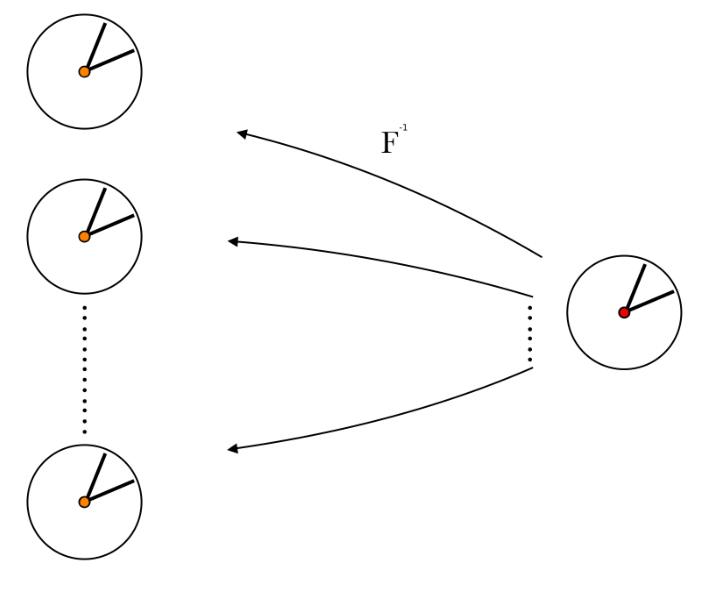
In this way, pulling back via \(F\) yields a triangulation \(T_X=(V_X,E_X,F_X)\) on \(X\) such that all branch points are contained in \(S_X\), and the preimage of each triangle of \(Y\) under \(F\) is a triangle in \(X\). If the vertices of the triangle are not branch points, we are in the situation described in the diagram below (property (1)):
If one of the vertices of the triangle is a branch point, we are in the situation described in the diagram below (property (2)):
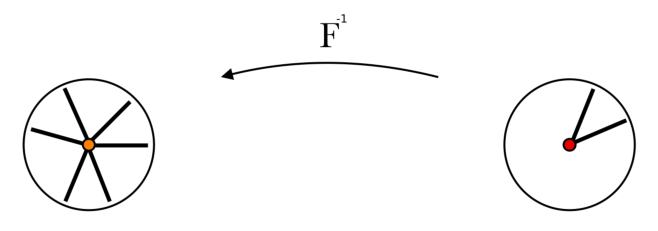
By construction of \(T_X\), we have \(|E_X|=\deg(F)|E_Y|\) and \(|F_X|=\deg(F)|F_Y|\). However, this equality does not hold for the vertices (it would if \(F\) were unbranched, i.e., if \(F\) were a covering). As seen in the second diagram, we need to add an error term \(-\bigl(\operatorname{mult}_x(F)-1\bigr)\) for each branch point \(x\in X\). We may even add this term for all \(x\), as it is zero when \(x\) is not a branch point. Thus, we obtain:
Corollary 1.1.21. Let \(F:X\to Y\) be a non-constant holomorphic map between compact Riemann surfaces. Let \(g(\cdot)\) denote the genus of a surface.
- If \(Y\cong\mathbb P^1\) and \(\deg(F)\ge2\), then \(F\) is branched.
- If \(g(X)=g(Y)=1\), then \(F\) is not branched.
- \(g(X)\ge g(Y)\).
- If \(g(X)=g(Y)\ge2\), then \(F\) is an isomorphism.
Proof. We will use Hurwitz’s formula to address each case.
Since \(Y\cong\mathbb P^1\), we have \(g(Y)=0\). If \(F\) were unbranched, then for any \(x\in X\), we would have \(\operatorname{mult}_x(F)-1=0\), and thus
\[2g(X)-2=-2\deg(F)\le-4,\]which implies \(g(X)\le-1\), an absurdity.
If \(g(X)=g(Y)=1\), then
\[\sum_{x\in X}\bigl(\operatorname{mult}_x(F)-1\bigr)=0,\]which implies that for all \(x\in X\), \(\operatorname{mult}_x(F)=1\). Hence, \(F\) is unbranched.
By Hurwitz’s formula, we immediately obtain:
\[2g(X)-2\ge\deg(F)\bigl(2g(Y)-2\bigr)\ge2g(Y)-2,\]so \(g(X)\ge g(Y)\).
We first recall why \(F\) is surjective, independently of the genus assumption: since \(F\) is non-constant, it is an open map. Moreover, by compactness of \(X\) and \(Y\), the image \(F(X)\) is compact and thus closed in \(Y\). By connectedness of \(Y\), we conclude that \(F(X)=Y\).
Now, from the assumptions on the genus of \(X\) and \(Y\), we have:
\[2\bigl(g(X)-1\bigr)\bigl(1-\deg(F)\bigr)=\sum_{x\in X}\bigl(\operatorname{mult}_x(F)-1\bigr).\]The term on the left is negative, while the term on the right is positive, so necessarily \(F\) is unbranched and \(\deg(F)=1\). By the definition of the degree, \(F\) is injective, so we conclude that \(F\) is a biholomorphism.
Remark 1.1.22. In particular, if \(F\) is branched and \(g(X)=1\), then \(Y\) is simply connected and therefore isomorphic to \(\mathbb P^1\).
1.2. Branched Covering
Definition 1.2.1. Let \(F:X\to Y\) be a continuous map between two oriented topological surfaces. We say that \(F\) is a branched covering if for any \(y\in Y\), there exist:
- A neighborhood \(U\) of \(y\) and a homeomorphism \(\Psi:U\to V\subset\mathbb C\).
- A function \(k:F^{-1}(\{y\})\to\mathbb N^*\).
- A diffeomorphism \(\phi:F^{-1}(U)\to V\times F^{-1}(\{y\})\) such that for all \(x\in F^{-1}(\{y\})\),
As mentioned earlier, we can think of \(F\) as a map that is “almost” a covering. The problematic points are the branch points, i.e., the points \(y\in Y\) such that there exists \(x\in F^{-1}(\{y\})\) with \(k(x)\ge2\). We observe that \(F\) is naturally surjective and that the branch points form a discrete subset of \(Y\).
Let us now prove the following proposition, which is more relevant to our discussion.
Proposition 1.2.2. Any non-constant, holomorphic, proper map \(F:X\to Y\) between two Riemann surfaces is a branched covering. In particular, if \(X\) and \(Y\) are compact, any non-constant holomorphic map from \(X\) to \(Y\) is a branched covering.
Proof. The fact that \(F\) is proper and non-constant ensures that the fibers of \(F\) are non-empty and have finite cardinality. It also allows us to treat the proof in a completely analogous way to Proposition 1.1.8, using the same compactness arguments based on the properness of \(F\).
Remark 1.2.3. We can further show that if \(X\) is compact (so is \(Y\)) and \(F\) is unbranched (i.e., it admits no branch points), then \(F\) is a (real one) covering. The argument follows from the fact that, by the definition of the degree of \(F\), all fibers have exactly the same cardinality. In particular, if \(\deg(F)=1\), then \(F\) is an isomorphism.
1.3. Punctured Compact Riemann Surface
Definition 1.3.1. A punctured compact Riemann surface is a Riemann surface \(X\) for which there exists an open set \(O\subset X\) such that:
- There is a biholomorphism between \(O\) and the disjoint union of a finite number of punctured disks \(\{0<|z|<1\}\).
- \(X\setminus O\) is compact.
We can associate to any punctured Riemann surface \(X\) a Riemann surface \(\widehat X\) constructed as follows: denoting by \((D_i^*=D_i\setminus\{z_i\})_{i\in I}\) the finite family of punctured disks such that \(O\cong\bigsqcup_{i\in I}D_i^*\) via a biholomorphism \(f\), we define
with \(Y=\bigsqcup_{i\in I}D_i\) and \(\sim\) the equivalence relation generated by \(a\sim f(a)\). By construction, we see that \(\widehat X\) is compact and that \(\widehat X\setminus X\) is finite.
Example 1.3.2. The Riemann sphere \(\mathbb P^1\) with finitely many points removed \(S\) is a punctured compact Riemann surface. Note that a punctured compact Riemann surface from which a finite number of points is removed remains a punctured compact Riemann surface.
Lemma 1.3.3. Let \(f:X\to Y\) be a finite (unbranched) covering of a punctured compact Riemann surface \(Y\). Then \(X\) is naturally endowed with a punctured compact Riemann surface structure that makes \(f\) holomorphic. Moreover, \(f\) extends uniquely to a holomorphic map \(\widehat f:\widehat X\to\widehat Y\).
Proof. Let \(d\) be the degree of the covering. Consider
a biholomorphic open set to a disjoint finite union of punctured disks such that \(Y\setminus O\) is compact.
For any \(y\in\widehat Y\setminus Y\), the restriction \(f|_{f^{-1}(D_y\setminus\{y\})}\) is a finite covering of \(D_y\setminus\{y\}\). Let \((C_i)_{i\in I_y}\) be the connected components of \(f^{-1}(D_y\setminus\{y\})\). Since \(f|_{C_i}:C_i\to D_y\setminus\{y\}\) is a finite connected covering of degree \(d\), it corresponds to a subgroup of index \(d\) of \(\pi_1(D_y\setminus\{y\})=\mathbb Z\) (noting that \(D_y\setminus\{y\}\) is homotopy equivalent to \(S^1\)).
This covering is therefore equivalent to the covering
and so \(C_i\) is biholomorphic to \(D_y\setminus\{y\}\) (see the end of Section ?? in the appendix).
The open set \(V=f^{-1}(O)\) is therefore biholomorphic to a disjoint finite union of punctured disks. Moreover, since \(f\) is a finite covering, it is in particular a proper map, which ensures the compactness of \(X\setminus V\) and thus the structure of a punctured compact Riemann surface on \(X\).
Now, let \(x_i\in\widehat X\setminus X\) be the point added to \(C_i\) such that \(\widehat{C_i}=C_i\cup\{x_i\}\) is isomorphic to \(D_y\). By setting \(\widehat f(x_i)=y\), we uniquely extend \(f\) to a holomorphic map \(\widehat f:\widehat X\to\widehat Y\), which completes the proof.
Remark 1.3.4. This lemma will be particularly useful for compactifying certain algebraic curves and computing their genus using the Riemann-Hurwitz formula.
Example 1.3.5.
- Let \(S\subset\mathbb C_\infty\) be a finite set, and let \(\pi:X\to\mathbb C_\infty\setminus S\) be an unbranched finite covering. Then \(X\) is a punctured compact Riemann surface.
(As motivation for what follows) Consider the algebraic curve
\[C=\{(x,y)\in\mathbb C^2\mid y^2=x(x-1)\}.\]Define \(\pi:(x,y)\in C\mapsto x\in\mathbb C\). The map \(\pi\) is a finite covering (of degree 2) and therefore induces a holomorphic map
\[\widehat\pi:\widehat C\to\mathbb C_\infty.\]The points 0 and 1 are the only branch points of \(\widehat\pi\) (we will later see why \(\infty\) is not). Since \(g(\mathbb C_\infty)=0\), applying Hurwitz’s formula gives \(g(\widehat C)=0\).
1.4. Algebraic Curves and Compactification
Let \(P\in\mathbb C[X,Y]\) be an irreducible polynomial of degree \(\ge1\). We define
By the implicit function theorem, \(C_P\) is a complex submanifold of dimension 1 in \(\mathbb C^2\). Moreover, a non-trivial theorem asserts that \(C_P\) is connected, thanks to the irreducibility of \(P\). For a proof of this result, see [Fisc].
Example 1.4.1.
If \(P(x,y)=y^2-x(x-1)\), then
\[C_P=\{(x,y)\in\mathbb C^2\mid y^2=x(x-1)\}.\]If \(P(x,y)=y^2-x^2(x-1)\), then
\[C_P=\{(x,y)\in\mathbb C^2\setminus\{(0,0)\}\mid y^2=x^2(x-1)\}.\]The zero locus of \(y^2-x^2(x-1)\) is not a Riemann surface; there is a double point at \((0,0)\), which must be removed to obtain a Riemann surface as in the previous example. On the other hand, this locus can be parametrized by the map
\[t\in\mathbb C\longmapsto\bigl(t^2(t-1),t^2\bigr)\in\{y^2=x^2(x-1)\}.\]
Assume that \(P\notin\mathbb C[x]\), i.e., that \(C_P\) is not a straight line parallel to the \(y\)-axis. Let \(n\) be the degree of \(y\) in \(P(x,y)\), and define the finite set
Setting
the map \(\pi_P:(x,y)\in X_P\mapsto x\in\mathbb C_\infty\setminus S\) is an unbranched covering of degree \(n\). By Lemma 1.3.3, \(X_P\) is a punctured compact Riemann surface, and so is \(C_P\). We then introduce the following definition:
Definition 1.4.2. The compact Riemann surface \(\widehat{X_P}=\widehat{C_P}\) is canonically associated with the algebraic curve defined by \(P\). We call \(\widehat{C_P}\) the compactification of \(C_P\).
1.4.3. Hyperelliptic Curves
Let \(h\) be a polynomial of degree \(2g+1+\epsilon\) (with \(g\ge0\) and \(\epsilon=0\) or 1), and assume that \(h\) has simple roots. The polynomial \(P(x,y)=y^2-h(x)\) is therefore irreducible, which gives
and
Each point \(x\) in \(\{h(x)=0\}\subset\mathbb C_\infty\) has a unique preimage in \(C_P\) (the point \((x,0)\)) under \(\pi_P\), so it is a branch point with a branching index of 2 (as \(\pi_P\) is of degree 2). Let us now analyze the case \(x=\infty\).
In Rick Miranda’s Algebraic Curves and Riemann Surfaces, the surface \(\widehat{C_P}\) can be obtained differently, giving better insight into its behavior at infinity. Define:
- \(U=\{(x,y)\in C_P\mid x\ne0\}\).
\(Y\subset\mathbb C^2\) as the smooth curve defined by
\[w^2=z^{2g+2}h(1/z),\]noting that \(z^{2g+2}h(1/z)\) is a polynomial.
- \(V=\{(z,w)\in Y\mid z\ne0\}\).
Assuming the isomorphism
we obtain the same compact variety by gluing \(X\) and \(Y\) along \(U\) and \(V\) thanks to \(\phi\):
From this perspective, the point \(\infty\) is a branch point of \(\widehat{\pi_P}\) if 0 is a branch point of the map
Noting \((a_i)_{i\in I}\) as the roots of \(h\), this amounts to studying the equation
Thus, \(\infty\) is a branch point of \(\widehat{\pi_P}\) if and only if \(\epsilon=0\) (i.e., if the degree of \(h\) is odd). The map \(\widehat{\pi_P}\) then has \(2g+2\) branch points, each with a branching index of 2.
By Hurwitz’s formula, we have
Thus, \(g(\widehat{C_P})=g\).
Definition 1.4.3 (Hyperelliptic Surfaces). A compact Riemann surface \(X\) is called hyperelliptic if there exists a holomorphic map \(X\to\mathbb C_\infty\) of degree 2.
Transcription notes — introduction
The text above reproduces the manuscript’s introduction, including its proofs and two diagrams. The formulas have been rewritten in LaTeX, and words split across lines or pages have been rejoined. The table of contents and the personal acknowledgements in the abstract have been omitted. The points below concern the original manuscript rather than the conversion of its glyphs.
- Definition 1.1.3, page 4. The local holomorphicity condition applies near every point of \(X\), with charts compatible with \(F\). The source wording “there exist two holomorphic charts” has been retained.
- Proofs 1.1.4–1.1.5, pages 4–5. In the identity principle proof, the chart of \(Y\) should be centred at \(F(x)=G(x)\), where the manuscript writes \(\phi(x)\). In the local normal form proof, \(U_1\subset X\) is a neighbourhood of \(p\); its image in a chart is a neighbourhood of 0.
- Degree and the Hurwitz formula, pages 7–10. In the compactness argument in 1.1.8, the contradiction concerns the subsequence \(x_{\phi(k)}\). The proof of 1.1.20 uses “branch points” for branch values in \(Y\), and writes \(S_X\) for the vertex set previously denoted by \(V_X\). Lifting a triangle means taking its different copies in the triangulation of \(X\).
- Corollary 1.1.21, page 12. In part (3), the second displayed inequality requires \(g(Y)\ge1\). The case \(g(Y)=0\) follows directly from \(g(X)\ge0\). In part (4), “negative” and “positive” should be read in the weak sense: non-positive and non-negative.
- Definition 1.2.1, page 12. In the product coordinates \(V\times F^{-1}(\{y\})\), the expression \(\phi^{-1}(z)\) is shorthand for the restriction to the component corresponding to \(x\), namely \(\phi^{-1}(z,x)\). The word “diffeomorphism” appears in the manuscript, although the surfaces are initially introduced as topological spaces.
- Lemma 1.3.3, page 14. The degree of the restriction to a component \(C_i\) is generally an integer \(d_i\), not necessarily the total covering degree \(d\). Local occurrences of \(d\), including in \(z\mapsto z^d\), should then be read as \(d_i\), with \(\sum_i d_i=d\). The reference “Section ??” is already unresolved in the PDF; Appendix 4.1 discusses coverings.
- Example 1.3.5, page 15. The projection of \(y^2=x(x-1)\) onto \(\mathbb C\) is a branched covering over 0 and 1. It becomes an unbranched covering after removing these values and their preimages.
- Example 1.4.1(3), page 16. The printed parametrisation \(t\mapsto(t^2(t-1),t^2)\) has been retained, but it does not satisfy the stated equation. For example, \(t=1\) gives \((0,1)\). A parametrisation of \(y^2=x^2(x-1)\) is \(t\mapsto(t^2+1,t(t^2+1))\), obtained by setting \(t=y/x\) away from the double point.
- Hyperelliptic curves, page 17. In the gluing construction, \(X\) denotes the affine chart \(C_P\). Writing \(h(x)=\prod_i(x-a_i)\) implicitly assumes that \(h\) is monic; for a leading coefficient \(c\ne0\), the corresponding equation is \(w^2=c\,z^{1-\epsilon}\prod_i(1-a_i z)\). Finally, the expressions \(\deg(\widehat{C_P})\) and \(\operatorname{mult}_a(\widehat{C_P})\) in the last formula are notational typos: the degree and multiplicities belong to the projection \(\widehat{\pi_P}:\widehat{C_P}\to\mathbb C_\infty\).
2. Group actions on Riemann surfaces
Definition 2.0.1. Let \(G\) be a group acting on a Riemann surface \(X\). We say that \(G\) acts:
- holomorphically if for any \(g\in G\), the map \(x\mapsto g.x\) is holomorphic from \(X\) into itself.
- effectively (or faithfully) if for any \(g\in G\), the condition \((x\mapsto g.x)=\mathrm{id}\) implies that \(g\) is trivial.
- properly discontinuously if for any compact set \(K\subset X\), the set \(\{g\in G:gK\cap K\ne\varnothing\}\) is finite.
- freely if for any \((g,x)\in G\times X\), the equality \(g.x=x\) implies that \(g\) is trivial.
Remark 2.0.2. Another equivalent definition for an action to be properly discontinuous: for any pair of compact sets \(K,K'\subset X\), the set \(\{g\in G:gK\cap K'\ne\varnothing\}\) is finite.
2.1. Cyclicity and finiteness of stabilizer subgroups
Proposition 2.1.1. Let \(G\) be a group acting holomorphically and faithfully on a Riemann surface \(X\). Let \(p\in X\) be fixed. If the stabilizer subgroup \(G_p\) is finite, then it is necessarily cyclic.
Proof. Let us choose a map \(\phi:U\longrightarrow V\subset\mathbb C\), where \(p\in U\), such that \(\phi(p)=0\). For \(g\in G_p\), denote the induced map:
\[\Gamma:G_p\longrightarrow\operatorname{Aut}(V),\]such that
\[\Gamma(g):z\in V\longmapsto\phi\circ g\circ\phi^{-1}(z)=\sum_{n\geq1}^{\infty}a_n(g)z^n\in\mathbb C.\]Note that the above power series has no constant term, since \(\phi(p)=0\). Since \(\Gamma(g)\) is holomorphic and injective on \(V\), its derivative \(\Gamma'(g)\) is nonzero everywhere, so \(a_1(g)=\Gamma'(g)(0)\ne0\). The map \(\Gamma\) therefore induces a map
\[a_1:G_p\longrightarrow\mathbb C^\times.\]We will now show that \(a_1\) is an injective group morphism, which completes the proof since \(G_p\cong a_1(G_p)=U_m\) for some \(m\in\mathbb N^*\). For all \(g,h\in G_p\),
\[\Gamma(g)\circ\Gamma(h)=\Gamma(gh),\]which implies
\[\Gamma(g)\circ\Gamma(h)(z)=\sum_{n\geq1}^\infty a_n(g)\left(\sum_{k\geq1}^\infty a_k(h)z^k\right)^n\equiv a_1(g)a_1(h)z\pmod{z^2}.\]Hence \(a_1\) is a group morphism. Now let \(g\in\ker(a_1)\), and we want to show that \(g\) is necessarily trivial. To do this, we show that for any \(z\in V\), we have \(\Gamma(g)(z)=z\), implying \(g.x=x\) for any \(x\in U\). Since \(X\) is connected, this equality extends to all of \(X\). As \(G\) acts effectively, \(g\) must be trivial.
Suppose for contradiction that there exists \(z\in V\) such that \(\Gamma(g)(z)\ne z\). Let \(m\) be the smallest integer \(m\geq2\) such that \(a_m(g)\ne0\). Then we have
\[\Gamma(g)(z)=z+a_m(g)z^m\pmod{z^{m+1}}.\]Now, since \(G_p\) is finite, there exists \(k\in\mathbb N^*\) such that \(g^k=e\), so
\[\Gamma(g^k)(z)\equiv z+ka_m(g)z^m\equiv z\pmod{z^{m+1}}.\]This implies \(a_m(g)=0\), a contradiction.
Proposition 2.1.2. Let \(G\) be a group acting holomorphically, properly discontinuously, and faithfully on a Riemann surface \(X\). Then the points \(x\) of \(X\) whose stabilizer \(G_x\) is non-trivial are discrete in \(X\).
Proof. Let \(U\subset X\) be a relatively compact open set. Let us denote the set (finite by hypothesis on \(U\)):
\[G_U=\{g\in G:gU\cap U\ne\varnothing\}.\]For \(g\in G_U\setminus\{\mathrm{id}\}\), denote by \((x_g^i)_i=\{x\in U:g.x=x\}\) the fixed points of \(g\) in \(U\), which is a finite set (denote \(n_g\) its cardinality). Indeed, if there were a sequence of distinct points \((x_n)_n\) in \((x_g^i)_i\), then, by the hypothesis on \(U\), we can assume (up to extracting a subsequence) that \((x_n)_n\) converges to a point \(x\in\bar U\). Since the holomorphic map \(x\mapsto g.x\) coincides with the identity on the set \(\{x_n:n\in\mathbb N\}\cup\{x\}\), which has \(x\) as an accumulation point, we conclude, by the connectedness of \(X\), that these two maps coincide on all of \(X\). Since the action of \(G\) on \(X\) is faithful, \(g\) must be the trivial element — a contradiction.
By separating \(X\), there exists a family \(\{U_g^i:g\in G_U\setminus\{\mathrm{id}\},1\leq i\leq n_g\}\) of pairwise disjoint open sets, each containing exactly one \(x_g^i\). By construction, \(x_g^i\) is the only point in \(U_g^i\) whose stabilizer subgroup is non-trivial.
Corollary 2.1.3. Let \(G\) be a group acting holomorphically and properly discontinuously on a Riemann surface \(X\). Then all stabilizer subgroups are finite and therefore cyclic.
Proof. Since the action is properly discontinuous, taking \(K=\{x\}\) for any \(x\in X\), we deduce that \(G_x\) is finite. By Proposition 2.1.1, this subgroup is cyclic.
2.2. Riemann quotient surface structure on \(X/G\)
Proposition 2.2.1. Let \(G\) be a group acting holomorphically, properly discontinuously, and faithfully on a Riemann surface \(X\). Let \(p\in X\). Then there exists an open neighborhood \(U\) of \(p\) such that:
- \(U\) is invariant under the action of \(G_p\);
- \(U\cap g.U=\varnothing\), for all \(g\notin G_p\);
- The canonical map \(\pi:X\longrightarrow X/G\) induces a homeomorphism
\[\overline{\pi|_U}:U/G_p\longrightarrow O\subset X/G,\]
where \(O\) is open in \(X/G\);
- No point of \(U\setminus\{p\}\) is fixed by a non-trivial element of \(G_p\).
Proof. By Proposition 2.1.2, let us take a relatively compact open neighborhood \(W\) of \(p\) such that for all \(x\in W\setminus\{p\}\), we have \(G_x=\{\mathrm{id}\}\). Let us denote:
\[(G\setminus G_p)\cap G_W=\{g_1,\ldots,g_k\},\]where \(G_W=\{g\in G:gW\cap W\ne\varnothing\}\). By the separation property of \(X\), and since for each \(i\in\{1,\ldots,k\}\) we have \(p\ne g_i.p\), there exists a pair of open sets \((U_i,V_i)\) such that \(p\in U_i\), \(g_i.p\in V_i\), and \(U_i\cap V_i=\varnothing\). Moreover, note that \(p\in g_i^{-1}(V_i)\).
Define:
\[V=\bigcap_{i=1}^{k}\left(g_i^{-1}(V_i)\cap U_i\right),\]which contains \(p\). Then \(g_iV\cap V=\varnothing\) for all \(i\in\{1,\ldots,k\}\). Now, setting:
\[U=\bigcap_{g\in G_p}g(V\cap W),\]we have \(gU=U\) for all \(g\in G_p\), i.e., \(U\) is invariant under the action of \(G_p\). Properties (b) and (d) follow directly.
To prove (c), note that the restriction \(\pi|_U:U\to X/G\) is open and continuous. This map factors as a homeomorphism:
\[\overline{\pi|_U}:U/G_p\longrightarrow\pi(U)\subset X/G,\]such that \(\pi|_U=\overline{\pi|_U}\circ q\), where \(q:U\to U/G_p\) is the natural projection onto the quotient.
Theorem 2.2.2. Let \(G\) be a group acting holomorphically, properly discontinuously, and faithfully on a Riemann surface \(X\). Then there exists a Riemann surface structure on \(X/G\) induced by the one on \(X\). Moreover, the canonical application \(\pi:X\longrightarrow X/G\) is holomorphic and satisfies the following properties:
- If \(G\) is finite, the degree of \(\pi\) is \(|G|\).
- For all \(p\in X\), \(\operatorname{mult}_p(\pi)=|G_p|\), where \(G_p\) is the stabilizer of \(p\).
Proof. (1) Construction of compatible charts on \(X/G\).
Let \(p\in X\). By Proposition 2.2.1, we can choose a neighborhood \(U\subset X\) of \(p\) and a homeomorphism \(\overline{\pi|_U}:U/G_p\to\pi(U)\subset X/G\) with the desired properties. Without loss of generality, assume that \(U\) is biholomorphic to an open set \(V\subset\mathbb C\) via a holomorphic map \(\phi:U\to V\). Using the family of holomorphic maps \(\Gamma(g)=\phi\circ g\circ\phi^{-1}\) for \(g\in G_p\), defined in Proposition 2.1.1, define:
\[h:z\in V\longmapsto\prod_{g\in G_p}\Gamma(g)(z),\qquad h:V\to\mathbb C.\]Clearly, \(h\) is holomorphic, and \(p\) is a zero of multiplicity \(|G_p|\) for the map \(H=h\circ\phi\). By restricting \(U\) further, we may assume that every point \(w\in H(U)\) admits precisely \(m=|G_p|\) preimages under \(H\), which are distinct when \(w\ne0\). Specifically, for any \(w=H(x)\in H(U)\), we have:
\[H^{-1}(\{w\})=G_p.x=\{g.x:g\in G_p\},\]since \(H\) is invariant under the action of \(G_p\):
\[H(g'.z)=\prod_{g\in G_p}\Gamma(gg'.z)=\prod_{g\in G_p}\Gamma(g.z)=H(z).\]By construction, \(|G_p.x|=m\) for all \(x\in U\setminus\{p\}\), so \(H\) factors into a homeomorphism:
\[\bar H:U/G_p\to V,\]such that \(H=\bar H\circ q\), where \(q:U\to U/G_p\) is the canonical quotient map. Since \(H\) is holomorphic, \(\bar H\) is automatically holomorphic as well. The map \(\bar H\circ\overline{\pi|_U}^{-1}:\pi(U)\to V\) thus defines a chart on \(X/G\).
The open sets \(\pi(U)\) cover \(X/G\), and the compatibility of charts on \(X\) induces, by construction, the compatibility of charts on \(X/G\).
(2) Riemann surface structure on \(X/G\). To show that \(X/G\) is a Riemann surface, we verify:
- Hausdorff space: If \(G.x\ne G.y\) in \(X/G\), then \(x\notin G.y\). Consider relatively compact neighborhoods \(O(x)\) and \(O(y)\) of \(x\) and \(y\), biholomorphic to small disks. For sufficiently small neighborhoods, the images \(\pi(O(x))\) and \(\pi(O(y))\) are disjoint, as otherwise we would have \(g.x=y\) for some \(g\in G\), contradicting \(x\notin G.y\).
- Connectedness: \(X/G\) is connected because \(X\) is connected and \(\pi:X\to X/G\) is continuous and surjective.
- Second countable: Since \(X\) has a countable basis \((O_n)_n\) of open sets, the images \(\pi(O_n)\) form a countable basis for \(X/G\).
(3) Properties of the map \(\pi:X\to X/G\). The map \(\pi\) is holomorphic because, locally, it is given by holomorphic maps as constructed above. By the properties of \(h\), we have that \(\operatorname{mult}_p(\pi)=|G_p|\). Moreover, when \(G\) is finite, \(\pi\) is of degree:
\[\deg(\pi)=\sum_{\bar g\in G/G_p}\operatorname{mult}_{g.p}(\pi)=|G/G_p|\cdot|G_p|=|G|.\]Lemma 2.2.3. Let \(G\) be a finite group acting holomorphically and faithfully on a compact Riemann surface \(X\). Let \(\pi:X\to Y=X/G\) denote the quotient map. Then, for any branch point \(y\in Y\), there exists an integer \(r\geq2\) such that:
- \(|\pi^{-1}(\{y\})|=|G|/r\).
- For any \(x\in\pi^{-1}(\{y\})\), we have \(\operatorname{mult}_x(\pi)=r\).
Proof. Let \(p\in X\), and take \(U\subset X\) a neighborhood of \(p\) as provided by Proposition 2.2.1. Then:
\[\pi^{-1}(\{\pi(p)\})=\{g.p:\bar g\in G/G_p\},\]and \(\operatorname{mult}_{g.p}(\pi)=|G_p|\). Set \(r=|G_p|\).
Corollary 2.2.4 (Genus Formula). Let \(G\) be a finite group acting holomorphically and faithfully on a compact Riemann surface \(X\). Let \(\pi:X\to Y=X/G\) denote the quotient map. Suppose there are \(k\) branch points \(y_1,\ldots,y_k\) in \(Y\), of respective multiplicities \(r_i\), each with \(|G|/r_i\) preimages. Then:
\[2g(X)-2=|G|(2g(X/G)-2)+\sum_{i=1}^{k}\frac{|G|}{r_i}(r_i-1).\]Alternatively:
\[2g(X)-2=|G|\left(2g(X/G)-2+\sum_{i=1}^{k}\left(1-\frac1{r_i}\right)\right).\]Proof. By application of Hurwitz’s formula to \(\pi:X\to X/G\), we have:
\[2g(X)-2=\deg(\pi)(2g(X/G)-2)+\sum_{p\in S}(\operatorname{mult}_p(\pi)-1),\]where \(S=\{x\in X:\operatorname{mult}_x(\pi)\geq2\}\) is the set of critical points. Summing over all contributions from the branch points, we find:
\[\sum_{p\in S}(\operatorname{mult}_p(\pi)-1)=\sum_{i=1}^{k}\frac{|G|}{r_i}(r_i-1).\]Substituting this into Hurwitz’s formula proves the desired result.
Lemma 2.2.5. Under the same assumptions as in Corollary 2.2.4, let \(R=\sum_{i=1}^{k}(1-1/r_i)\). Then:
\[\begin{aligned}\text{(a)}\quad R<2\quad\Longleftrightarrow\quad&\begin{cases}k=1,\quad r_1\text{ any},\\k=2,\quad r_1,r_2\text{ any, or}\\k=3,\quad\{r_i\}=\{2,2,r_3\},\quad r_3\text{ any, or}\\k=3,\quad\{r_i\}=\{2,3,3\},\{2,3,4\},\text{ or }\{2,3,5\};\end{cases}\\[1ex]\text{(b)}\quad R=2\quad\Longleftrightarrow\quad&\begin{cases}k=3,\quad\{r_i\}=\{2,3,6\},\{2,4,4\},\text{ or }\{3,3,3\},\text{ or}\\k=4,\quad\{r_i\}=\{2,2,2,2\}.\end{cases}\end{aligned}\](c) If \(R>2\), then \(R\geq2+1/42\), with equality if and only if \(k=3\), \(\{r_i\}=\{2,3,7\}\).
Proof. We verify the direct and reciprocal implications for each equivalence.
- Assume \(R<2\). Necessarily, \(k<4\) because \(r_i\geq2\) implies \(R\geq k/2\), so \(k\geq4\implies R\geq2\) (contradiction). The cases \(k=1,2\) are trivial. If \(k=3\), note that: \(r_1\geq3\implies R\geq3-1/3-1/3-1/r_3\geq2\), so \(r_1=2\). In this case, explicit enumeration of pairs \((r_2,r_3)\) yields the stated possibilities.
- Assume \(R=2\). Since \(r_i\geq2\), necessarily \(k=3\) or \(k=4\). If \(k=4\), all \(r_i=2\) to avoid \(R>2\). If \(k=3\), solving \(\sum1/r_i=1\) gives the listed solutions.
- Assume \(R>2\). From part (b) of Lemma 2.2.5, \(k\geq3\). If \(k=4\), \(r_4\geq3\) implies \(R\geq4-3/2\geq2+1/42\). If \(k=3\), the tightest bound \(R=2+1/42\) occurs if \(r_1=2,r_2=3,r_3=7\).
2.3. Hurwitz theorem
Theorem 2.3.1 (Hurwitz’s theorem). Let \(X\) be a compact Riemann surface of genus \(g(X)\geq2\). Then \(G=\operatorname{Aut}(X)\) is a finite group of order at most \(84(g(X)-1)\).
Demonstration. For the moment, we’ll assume that \(G\) is finite. We’ll demonstrate this later. Let \(\pi:X\longrightarrow X/G\) be the quotient application. Let \(R\) be the quantity \(\sum_{i=1}^k(1-1/r_i)\). By the genus formula we have
\[2(g(X)-1)=|G|(2g(X/G)-2+R).\]- If \(g(X/G)\geq1\) and \(R=0\), then \(g(X)-1=|G|(g(X/G)-1)\). This implies \(g(X/G)\geq2\) (because \(g(X)\geq2\)), so \(g(X)-1\geq|G|\).
- If \(g(X/G)\geq1\) and \(R\ne0\), then \(R=\sum_{i=1}^k(1-1/r_i)\geq1/2\), so
\[\frac{2(g(X)-1)}{|G|}=2(g(X/G)-1)+R\geq2(g(X/G)-1)+\frac12.\]
So \(\frac{g(X)-1}{|G|}\geq g(X/G)-1+1/4\geq1/4\), and so \(|G|\leq4(g(X)-1)\).
- If \(g(X/G)=0\), then \(0<2(g(X)-1)=|G|(R-2)\). This implies \(R>2\), so by the previous lemma \(R-2\geq1/42\), and so \(|G|\leq84(g(X)-1)\).
Remark 2.3.2.
- We will also show later that the bound \(84(g(X)-1)\) is optimal, in the sense that it can be reached (in the case \(g(X)=3\), for example). In the 1960s, A. M. Macbeath showed that this bound is reached infinitely many times, but also that it is not reached in infinitely many cases (see [Macb]). Moreover, a finite group \(G\) acting holomorphically and faithfully on a compact Riemann surface of genus \(g\geq2\) is called a Hurwitz group if it reaches the Hurwitz bound. It can be shown (we omit the details here) that \(G\) is a Hurwitz group if and only if it is generated by two elements \(x\) and \(y\) satisfying the relations: \[x^2=y^3=(xy)^7=1.\]
- In the case where \(X\) is a hyperelliptic Riemann surface, it can be shown that the involution \(\sigma(x,y)=(x,-y)\) is central in \(\operatorname{Aut}(X)\). (Recall that the application \(\widehat\pi_P:X\to\mathbb C_\infty\) is of degree \(2\) and induces an isomorphism \(X/\langle\sigma\rangle\cong\mathbb C_\infty\), see [Fark] for a detailed presentation on this topic.) Each element of \(\operatorname{Aut}(X)/\langle\sigma\rangle\) can thus be seen as an element of \(\operatorname{Aut}(\mathbb C_\infty)\), which leaves the branch points stable. Since \(\operatorname{Aut}(\mathbb C_\infty)\) acts strictly 3-transitively on \(\mathbb C_\infty\) (i.e., for any pair of triplets \((x_1,x_2,x_3)\) and \((y_1,y_2,y_3)\) of distinct elements of \(\mathbb C_\infty\), there exists a unique \(f\in\operatorname{Aut}(\mathbb C_\infty)\) such that \(f(x_i)=y_i\) for all \(i\)), this group is necessarily finite. Moreover, since \(\operatorname{Aut}(X)\) is an extension of \(\operatorname{Aut}(X)/\langle\sigma\rangle\) by \(\langle\sigma\rangle\), \(\operatorname{Aut}(X)\) is necessarily finite.
2.4. Finiteness of \(\operatorname{Aut}(X)\) via Fuchsian groups
In this section, we briefly introduce Fuchsian groups to demonstrate, along with other results, that \(\operatorname{Aut}(X)\) is finite under the assumptions of Theorem 2.3.1. We’ll also take this opportunity to prove the “second” uniformization theorem. Denote the upper half-plane by \(\mathbb H=\{z\in\mathbb C,\Im(z)>0\}\).
Definition 2.4.1. A Fuchsian group is a discrete subgroup of \(\operatorname{PSL}(2,\mathbb R)\).
Theorem 2.4.2. Let \(\Gamma\) be a subgroup of \(\operatorname{PSL}(2,\mathbb R)\) acting on \(\mathbb H\). The action is properly discontinuous if and only if \(\Gamma\) is discrete (i.e., Fuchsian).
Proof. \((1)\implies(2)\). Reason by contrapositive: assume that \(\Gamma\) is not discrete. Then there exists a sequence \((T_n)_n\) of distinct elements of \(\Gamma\) converging to the identity map in \(\operatorname{PSL}(2,\mathbb R)\). Let \(p\in\mathbb H\) be arbitrary. Take a relatively compact neighborhood \(O\) of \(p\). There exists \(n_0\in\mathbb N\) such that for any \(n\geq n_0\), \(T_n(O)\cap O\ne\varnothing\). Therefore, the action is not properly discontinuous.
\((2)\implies(1)\). Assume that \(\Gamma\) is discrete. Let \(K\) and \(F\) be two compact subsets of \(\mathbb H\). Define the (continuous) map:
\[\phi:\operatorname{SL}(2,\mathbb R)\times F\xrightarrow{p\times\mathrm{id}}\operatorname{PSL}(2,\mathbb R)\times F\xrightarrow{\mathrm{ev}}\mathbb H,\]where \(p\) is the canonical projection, and \(\mathrm{ev}\) is the evaluation map given by \((A,z)\mapsto A.z\). We show that \(E=\{(T,z)\in\operatorname{PSL}(2,\mathbb R)\times F:T.z\in K\}\) is compact. To do this, we verify that \(\widetilde E=(p\times\mathrm{id})^{-1}(E)\subset\operatorname{SL}(2,\mathbb R)\times F\) is compact. Compactness of \(\widetilde E\) implies that \(\{T\in\Gamma:T(F)\cap K\ne\varnothing\}\) is finite, since \(\Gamma\) is discrete.
By compactness of \(K\) and \(F\), and continuity of \(\phi\), there exist constants \(C_1>0\) and \(C_2>0\) such that \(|\phi(\widetilde E)|\leq C_1\) and \(\Im(\phi(\widetilde E))\geq C_2\). In other words, for \(\left(\begin{pmatrix}a&b\\c&d\end{pmatrix},z\right)\in\widetilde E\), we have \(\left|\frac{az+b}{cz+d}\right|\leq C_1\) and \(\frac{\Im(z)}{|cz+d|^2}\geq C_2\). The second condition implies that \(c\) and \(d\) are bounded. Substituting into the first condition shows that \(a\) and \(b\) are also bounded. This completes the proof.
Remark 2.4.3. We can immediately deduce that if \(K\leq\operatorname{PSL}(2,\mathbb R)\) is a Fuchsian group, then \(\mathbb H/K\) is a Riemann surface, with the canonical projection \(\mathbb H\to\mathbb H/K\) holomorphic. Moreover, we recall that \(\operatorname{Aut}(\mathbb H)\cong\operatorname{PSL}(2,\mathbb R)\) via the group action:
\[\begin{pmatrix}a&b\\c&d\end{pmatrix}.z=\frac{az+b}{cz+d}.\]Theorem 2.4.4 (Uniformization of related surfaces, version 2). Any connected Riemann surface \(X\) is biholomorphic to one of the following surfaces: \(\mathbb C\), \(\mathbb C^*=\mathbb C\setminus\{0\}\), a complex torus \(\mathbb C/\Lambda\), the Riemann sphere \(\mathbb C_\infty\), or \(\mathbb H/K\), where \(K\) is a Fuchsian group acting freely on \(\mathbb H\).
Proof. Let \(X\) be a Riemann surface. Let \(p:\widetilde X\to X\) be a universal covering map. The theory of covering spaces ensures that the group of automorphisms of \(p\) (denoted \(A(p)\)) acts properly discontinuously and freely on \(\widetilde X\), and induces a homeomorphism \(\bar p:\widetilde X/A(p)\to X\). (See [Live] for details if necessary.)
By definition of \(p\) and \(X\), Lemma 4.1.2 and Theorem 2.2.2 ensure that \(\bar p\) is, in fact, a biholomorphism of Riemann surfaces.
Moreover, the First Uniformization Theorem (1.1.18) ensures that \(\widetilde X\) is biholomorphic to one of \(\mathbb C,\mathbb C^*,\mathbb H\), or \(\mathbb C_\infty\).
- Case \(\widetilde X=\mathbb C_\infty\): The map \(\pi:\mathbb C_\infty\to\mathbb C_\infty/A(p)\) is holomorphic and non-constant between compact Riemann surfaces. By Corollary 1.1.21, \(g(\mathbb C_\infty/A(p))=0\), and hence \(X\cong\mathbb C_\infty\).
- Case \(\widetilde X=\mathbb C\): The group \(A(p)\) is a subgroup of the group of affine transformations of \(\mathbb C\), which consists of translations. Since the action has no fixed points, the elements of \(A(p)\) are of the form \(z\mapsto z+w\) (\(w\in\mathbb C\)). Because the action is also discontinuous, \(A(p)\) can be identified with a discrete additive subgroup of \(\mathbb C\) (a lattice).
- If the rank of \(A(p)\) is zero, then \(X\cong\mathbb C\).
- If \(A(p)\) is monogenic (\(A(p)=w\mathbb Z\)), then \(X\cong\mathbb C/A(p)\), which is isomorphic to \(\mathbb C^*\) via \(z\in\mathbb C/w\mathbb Z\mapsto e^{2i\pi z/w}\in\mathbb C^*\).
- If \(A(p)\) has rank \(2\), then \(X\) is isomorphic to a complex torus.
- Case \(\widetilde X=\mathbb H\): By Theorem 2.4.2, \(A(p)\) is a Fuchsian group that acts freely on \(\mathbb H\). Here, \(X\cong\mathbb H/A(p)\).
Remark 2.4.5. Consider a compact Riemann surface \(X\) of genus \(g\geq2\). By Theorem 1.1.14, \(X\) is homeomorphic to the connected sum of \(g\) tori. Using van Kampen’s theorem (see Section 4.2), we can show that:
\[\pi_1(X)\cong\left\langle a_1,b_1,\ldots,a_g,b_g\ \middle|\ \prod_{i=1}^{g}[a_i,b_i]=1\right\rangle.\]Moreover, the theory of covering spaces ensures that \(A(p)\cong\pi_1(X)\), because \(\widetilde X\) is simply connected. Therefore, \(A(p)\) is non-abelian.
Lemma 2.4.6. Let \(K\) be a Fuchsian group. Let \(\pi:\mathbb H\longrightarrow\mathbb H/K\) the canonical projection. Suppose there exist \(\tilde f_1,\tilde f_2\), two automorphisms of \(\mathbb H\), such that \(\pi\circ\tilde f_1=\pi\circ\tilde f_2\). Then \(\tilde f_1\circ\tilde f_2^{-1}\in K\).
Proof. If \(\pi\circ\tilde f_1=\pi\circ\tilde f_2\), then for any \(z\in\mathbb H\), there exists \(k_z\in K\) such that \(\tilde f_1.z=k_z.\tilde f_2.z\). This induces the app
\[z\in\mathbb H\longmapsto k_z\in K.\]Since \(K\) is countable, at least one fiber of this map is uncountable. In other words, there exists \(k\in K\) such that the set \(\{z\in\mathbb H\mid\tilde f_1.z=k.\tilde f_2.z\}\) is uncountable and therefore has an accumulation point. By connectedness of \(\mathbb H\), we have \(\tilde f_1=k\circ\tilde f_2\) and deduce the result.
Theorem 2.4.7. Let \(X\) be a Riemann surface isomorphic to \(\mathbb H/K\), where \(K\) is a Fuchsian group (\(K\leq\operatorname{PSL}(2,\mathbb R)\)). Then:
\[\operatorname{Aut}(X)\cong N(K)/K,\]where \(N(K)=\{g\in\operatorname{PSL}(2,\mathbb R)\mid gKg^{-1}=K\}\) is the normalizer of \(K\) in \(\operatorname{PSL}(2,\mathbb R)\).
Proof. Assume \(X=\mathbb H/K\). Let \(\pi:\mathbb H\to\mathbb H/K\) be the canonical projection. Let \(f\in\operatorname{Aut}(X)\). Since \(f\circ\pi:\mathbb H\to\mathbb H/K\) is a covering map, there exists a biholomorphism \(\tilde f\in\operatorname{Aut}(\mathbb H)\) such that \(f\circ\pi=\pi\circ\tilde f\). For all \(k\in K\), for all \(z\in\mathbb H\), we have:
\[\pi\circ\tilde f\circ k\circ\tilde f^{-1}(z)=f\circ\pi\circ k\circ\tilde f^{-1}(z)=f\circ\pi\circ\tilde f^{-1}(z)=\pi(z).\]By Lemma 2.4.6, \(\tilde f\in N(K)\). This induces a group morphism:
\[\phi:f\in\operatorname{Aut}(X)\longmapsto[\tilde f]\in N(K)/K.\]If \([\tilde f]=K\), then \(\tilde f\in K\), and thus \(f=\mathrm{id}\). Hence, \(\phi\) is injective.
For surjectivity, let \(\tilde g\in N(K)\) be arbitrary. By the universal property of quotients, there exists a bijective \(g:\mathbb H/K\to\mathbb H/K\) such that \(g\circ\pi=\pi\circ\tilde g\). Since \(\pi\) is a local biholomorphism, \(g\in\operatorname{Aut}(\mathbb H/K)\).
Lemma 2.4.8. Let \(K\) be a non-abelian Fuchsian group. Then \(N(K)\), the normalizer of \(K\), is also a Fuchsian group.
A group-theoretic result (see [Cejk]) states that two elements of \(\operatorname{PSL}(2,\mathbb R)\setminus\{\mathrm{id}\}\) commute if and only if they have exactly the same fixed points (on \(\overline{\mathbb H}\)). We use this result to prove the above lemma.
Proof of Lemma 2.4.8. We proceed by contradiction. Suppose there exists a sequence \((g_n)_n\subset N(K)\) converging to \(\mathrm{id}\). For any \(h\in K\), the sequence \((g_nhg_n^{-1})_n\) lies in \(K\) (since \(g_n\in N(K)\)) and converges to \(h\). But since \(K\) is discrete, this sequence must be eventually constant. Hence, for sufficiently large \(n\), \(g_n\) and \(h\) commute, and therefore \(g_n\) fixes the same points on \(\overline{\mathbb H}\) as \(h\). As \(h\) is arbitrary, this would imply that all elements of \(K\) have the same fixed points and thus commute, contradicting the hypothesis that \(K\) is non-abelian. This completes the proof.
We are now close to completing the proof of Hurwitz’s theorem. Before proceeding, we introduce the concept of a fundamental domain.
Definition 2.4.9 (Fundamental domain). Let \(\Gamma\) be a subgroup of \(\operatorname{PSL}(2,\mathbb R)\). A fundamental domain for the action of \(\Gamma\) on \(\mathbb H\) is a closed subset \(F\subset\mathbb H\) satisfying:
- \(\overline{\mathring F}=F\),
- \(\mathbb H=\bigcup_{T\in\Gamma}T(F)\),
- For all \(T\in\Gamma\setminus\{\mathrm{id}\}\), \(\mathring F\cap T(\mathring F)=\varnothing\).
The hyperbolic area of a subset \(A\subset\mathbb H\) is defined as:
\[\mu(A)=\int_A\frac{dx\,dy}{y^2}.\]If \(F_1,F_2\subset\mathbb H\) are two fundamental domains for a subgroup \(\Gamma\subset\operatorname{PSL}(2,\mathbb R)\), we always have:
\[\mu(F_1)=\sum_{T\in\Gamma}\mu(F_1\cap T(F_2))=\sum_{T\in\Gamma}\mu(T^{-1}(F_1)\cap F_2)=\mu(F_2).\]Moreover, if \(\Gamma\) is a Fuchsian group, we can show that:
\[D_p(\Gamma)=\{z\in\mathbb H:d(z,p)\leq d(T(z),p),\text{ for all }T\in\Gamma\}\]is a fundamental domain for the action of \(\Gamma\) on \(\mathbb H\), where \(p\in\mathbb H\) and \(d\) is the hyperbolic distance on \(\mathbb H\) (defined via the hyperbolic metric \(ds^2=(dx^2+dy^2)/y^2\)). See [Kato] for a proof of this result. The sets \(D_p(\Gamma)\) are called Dirichlet regions.
For any Fuchsian group \(\Gamma\), we define \(\mu(F)\), the hyperbolic area of any fundamental domain \(F\), and denote this directly as \(\mu(\Gamma)\).
In [Kato], it is also shown that \(\mathbb H/\Gamma\) is compact if and only if every Dirichlet region \(D_p(\Gamma)\) is compact.
Finally, if \(\Lambda\) is a subgroup of \(\Gamma\), then:
\[\mu(\Lambda)=[\Gamma:\Lambda]\cdot\mu(\Gamma),\tag{1}\]where \([\Gamma:\Lambda]\) denotes the index of \(\Lambda\) in \(\Gamma\). (See the appendix for a proof of this result.)
Proof of Hurwitz’s theorem (2.3.1)—continued. Let us now show that \(\operatorname{Aut}(X)\) is finite. By the Uniformization Theorem (2.4.4), we have \(X\cong\mathbb H/K\), where \(K\) is a Fuchsian group that acts freely on \(\mathbb H\). Consider:
- \(K\) is non-abelian by Remark 2.4.5.
- \(N(K)\) is a Fuchsian group by Lemma 2.4.8.
- By Theorem 2.4.7, \(\operatorname{Aut}(X)\cong N(K)/K\).
Since \(X\) is compact, \(\mu(K)<\infty\), and hence \(\mu(N(K))<\infty\) by Equation 1. Thus:
\[|\operatorname{Aut}(X)|=|N(K):K|=\frac{\mu(N(K))}{\mu(K)}<\infty.\]This completes the proof.
Remark 2.4.10. Note that \(\mu(N(K))>0\). To see this, let \(F\) be a fundamental domain for \(N(K)\). If \(\mu(F)=0\), then \(F\) would have empty interior, and hence \(F\) would be empty (since \(\overline{\mathring F}=F\)). Hence, the equality \(\mathbb H=\bigcup_{T\in N(K)}T(F)\) would not hold, which is a contradiction.
3. Examples of Finite Group Actions and Related Results
In this section, we will consider several examples of actions of finite groups on compact surfaces of different genus \(g\) (\(0\) to \(3\)). For the cases \(g=0\) and \(g=1\), we will analyze different possible situations identified in Lemma 2.2.5 (cases (a) and (b) of the lemma). We will also calculate some explicit branch points by way of example. The case \(g=2\) will briefly discuss the possible groups acting on hyperelliptic surfaces, without explicit calculations. Finally, as announced in the introduction, the case \(g=3\) will cover Klein quartics in detail.
3.1. Actions on the Riemann sphere (\(g=0\))
Let us begin by analyzing finite group actions on the Riemann sphere \(\mathbb C_\infty\). If \(G\) is a finite group acting holomorphically and effectively on \(\mathbb C_\infty\), then since \(\mathbb C_\infty\) has genus \(0\), so does \(\mathbb C_\infty/G\) (by Corollary 1.1.21). Using the genus formula (Corollary 2.2.4), we find:
\[-2=|G|(R-2),\]where \(R=\sum_{i=1}^k(1-1/r_i)\), with \(r_1,\ldots,r_k\) being the branching indices of the branch points \(y_1,\ldots,y_k\in\mathbb C_\infty/G\). Since \(R<2\), we fall into case (a) of Lemma 2.2.5. Thus, we necessarily have \(k\leq3\).
Recall that the group of automorphisms of \(\mathbb C_\infty\) is:
\[\left\{z\in\mathbb C_\infty\longmapsto\frac{az+b}{cz+d}\ \middle|\ ad-bc\ne0\right\}.\]This induces a surjective morphism:
\[\begin{pmatrix}a&b\\c&d\end{pmatrix}\in\operatorname{GL}_2(\mathbb C)\longmapsto\left(z\longmapsto\frac{az+b}{cz+d}\right)\in\operatorname{Aut}(\mathbb C_\infty).\]Noting that the kernel of this morphism is the subgroup of homotheties, we obtain the isomorphism:
\[\operatorname{PGL}_2(\mathbb C)\cong\operatorname{Aut}(\mathbb C_\infty).\]Thus, \(\operatorname{PGL}_2(\mathbb C)\) acts (via homography) holomorphically and effectively on \(\mathbb C_\infty\), with:
\[\begin{pmatrix}a&b\\c&d\end{pmatrix}.z=\frac{az+b}{cz+d}.\]Finite subgroups of \(\operatorname{PGL}_2(\mathbb C)\)
Dickson’s theorem states that any finite subgroup of \(\operatorname{PGL}_2(\mathbb C)\) is isomorphic to one of the following groups:
\[\mathbb Z/n\mathbb Z,\qquad D_{2r},\qquad A_4,\qquad S_4,\qquad\text{or }A_5.\]We will focus on the last four.
1. Action of \(D_{2r}\) on \(\mathbb C_\infty\)
The dihedral group \(D_{2r}\) has the presentation:
\[D_{2r}=\langle\alpha,\beta\mid\alpha^r=\beta^2=1,\ \beta\alpha\beta^{-1}=\alpha^{-1}\rangle.\]It is straightforward to verify that:
\[D_{2r}\cong\langle z\mapsto e^{2\pi i/r}z,\ z\mapsto1/z\rangle,\]where \(e^{2\pi i/r}z\) and \(1/z\) are two elements of \(\operatorname{Aut}(\mathbb C_\infty)\). To find the branch points of the quotient map, we look for points \(z\in\mathbb C_\infty\) whose stabilizing subgroup \(G_z\) is non-trivial. We analyze the fixed points of \(\alpha\), \(\beta\), and \(\alpha\beta\):
- \(\alpha.z=z\iff e^{2\pi i/r}z=z\iff z\in\{0,\infty\}\). Since \(\infty\) lies on the same orbit as \(0\), we have \(G_0=\langle\alpha\rangle\), which has order \(r\). Thus, \(D_{2r}.0\) is a branch point of order \(r\).
- \(\beta.z=z\iff1/z=z\iff z\in\{-1,1\}\). If \(r\) is even, \(-1\) and \(1\) are in the same orbit. Here, \(G_1=\langle\beta\rangle\), which has order \(2\). Thus, \(D_{2r}.1\) is a branch point of order \(2\).
- \((\alpha\beta).z=z\iff e^{2\pi i/r}z^2=z\iff z\in\{e^{\pi i/r},-e^{\pi i/r}\}\). If \(r\) is even, these two points are also in the same orbit. The stabilizer is \(G_{e^{\pi i/r}}=\langle\alpha\beta\rangle\), which has order \(2\). Thus, \(D_{2r}.e^{\pi i/r}\) is a branch point of order \(2\).
We have shown that the branch points of the quotient map are \(D_{2r}.0\), \(D_{2r}.1\) and \(D_{2r}.e^{\pi i/r}\) with respective indices \(r,2,2\). By Lemma 2.2.5, there are no other branch points.
2. Actions of \(A_4,S_4,A_5\) on \(\mathbb C_\infty\)
Let us now analyze the cases of \(A_4,S_4,A_5\). These groups have the following presentations:
\[A_4=\langle\alpha,\beta\mid\alpha^3=\beta^2=(\alpha\beta)^3=1\rangle,\] \[S_4=\langle\alpha,\beta\mid\alpha^4=\beta^2=(\alpha\beta)^3=1\rangle,\] \[A_5=\langle\alpha,\beta\mid\alpha^5=\beta^2=(\alpha\beta)^3=1\rangle.\]We choose generators satisfying these relations, e.g.,
\[A_4\cong\left\langle e^{2\pi i/3}z,\frac{\sqrt2-z}{\sqrt2z+1}\right\rangle,\qquad S_4\cong\left\langle iz,\frac{z+1}{z-1}\right\rangle,\] \[A_5\cong\left\langle e^{2\pi i/5}z,\frac{z+\lambda}{\lambda z-1}\right\rangle,\qquad\lambda=\sqrt{1-2\cos(2\pi/5)}.\]The stabilizer for \(z=0\) has order \(3,4\), or \(5\), respectively. Using Lemma 2.2.5, the branch points of each action can be determined explicitly.
3.2. Actions on a complex torus (\(g=1\))
Let \(\mathbb C/\Lambda\) be a complex torus with \(\Lambda=\omega_1\mathbb Z\oplus\omega_2\mathbb Z\) a lattice in \(\mathbb C\). Before analyzing group actions on \(\mathbb C/\Lambda\), let us first classify its automorphisms.
Proposition 3.2.1. Let \(\mathbb C/\Lambda_1\) and \(\mathbb C/\Lambda_2\) be two tori. The holomorphic (non-constant) maps \(f:\mathbb C/\Lambda_1\to\mathbb C/\Lambda_2\) are exactly the maps of the form:
\[f_{a,b}:[z]_1\in\mathbb C/\Lambda_1\longmapsto[az+b]_2\in\mathbb C/\Lambda_2,\]where \(a,b\in\mathbb C\) and \(a\Lambda_1\subseteq\Lambda_2\).
Proof. Let’s denote \(\pi_i:\mathbb C\to\mathbb C/\Lambda_i\) the canonical projection (which is also the unique universal covering of \(\mathbb C/\Lambda_i\)). Let \(f:\mathbb C/\Lambda_1\to\mathbb C/\Lambda_2\) be a holomorphic map. The composition \(f\circ\pi_1:\mathbb C\to\mathbb C/\Lambda_2\) is a universal covering of \(\mathbb C/\Lambda_2\). Therefore, there exists a covering automorphism \(\tilde f:\mathbb C\to\mathbb C\) such that \(f\circ\pi_1=\pi_2\circ\tilde f\). From this, we deduce that \(\tilde f\) is a biholomorphic map of the form \(\tilde f(z)=az+b\) (this follows from standard results on universal coverings). Consequently, \(f=f_{a,b}\). Furthermore, for any \(\omega\in\Lambda_1\), we must have:
\[f([z+\omega]_1)=f([z]_1)\implies[az+b+a\omega]_2=[az+b]_2\implies a\omega\in\Lambda_2.\]Thus, \(a\Lambda_1\subseteq\Lambda_2\).
Conversely, if \(f_{a,b}:[z]_1\mapsto[az+b]_2\) is defined with \(a\Lambda_1\subseteq\Lambda_2\), then it is easy to verify that \(f_{a,b}\) is well-defined and holomorphic since \(\pi_i\) are local biholomorphisms.
Corollary 3.2.2. \(f_{a,b}\) is an isomorphism if and only if \(a\Lambda_1=\Lambda_2\).
Proof. \((\implies)\) Assume \(f_{a,b}\) is an isomorphism. Denote its inverse by \(f_{c,d}\), where \(f_{c,d}([z]_2)=[cz+d]_1\). As \(f_{a,b}\circ f_{c,d}([z]_2)=[z]_2\), we have:
\[f_{a,b}(f_{c,d}([z]_2))=[z]_2\implies[acz+ad+b]_2=[z]_2.\]Since \(\mathbb C/\Lambda_2\) is discrete, this implies \(ac=1\) and \(b+ad\in\Lambda_2\). Thus, \(c=a^{-1}\) and \(a\Lambda_1=\Lambda_2\).
\((\impliedby)\) Conversely, if \(a\Lambda_1=\Lambda_2\), then \(a^{-1}\Lambda_2\subseteq\Lambda_1\). It follows that the map \(f_{a^{-1},-a^{-1}b}\) is well-defined, holomorphic, and inverse to \(f_{a,b}\).
Remark 3.2.3. In the case of an automorphism of \(\mathbb C/\Lambda\), we can show that \(|a|=1\). Indeed, since \(\mathbb C/\Lambda\) is compact and discrete, consider \(\omega\in\Lambda\setminus\{0\}\) of minimal modulus. Then:
\[|\omega|\leq|a\omega|\qquad\text{and}\qquad|\omega|\leq|a^{-1}\omega|,\]which implies \(|a|=1\).
Let \(T\subset\operatorname{Aut}(\mathbb C/\Lambda)\) be the (infinite) subgroup generated by translations (\([z]\mapsto[z+b]\)) with \(b\in\mathbb C\). Denote also \(\operatorname{Aut}_0(\mathbb C/\Lambda)\) the subgroup generated by automorphisms fixing \(0\) (\([z]\mapsto[az]\), with \(a\in\mathbb C\)). The subgroup \(T\) is normal in \(\operatorname{Aut}(\mathbb C/\Lambda)\), and by the previous results, \(\operatorname{Aut}_0(\mathbb C/\Lambda)\) is a complement of \(T\) in \(\operatorname{Aut}(\mathbb C/\Lambda)\). Hence, group theory implies:
\[\operatorname{Aut}(\mathbb C/\Lambda)=T\rtimes\operatorname{Aut}_0(\mathbb C/\Lambda).\]Lemma 3.2.4. \(\operatorname{Aut}_0(\mathbb C/\Lambda)\) is a cyclic group of order \(2,4\), or \(6\).
Proof. Let \(f:[z]\mapsto[az]\) be an element of \(\operatorname{Aut}_0(\mathbb C/\Lambda)\). Let \(\omega\in\Lambda\setminus\{0\}\) be a lattice point of minimal modulus. By Remark 3.2.3, we know \(|a|=1\). Exclude the trivial case \(a=\pm1\).
Since \(a\ne\pm1\) and \(a\Lambda=\Lambda\), we have \(\langle\omega,a\omega\rangle=\Lambda\) and \(a^2\omega\in\Lambda\). Thus, there exist integers \(m\) and \(n\) such that \(a^2=ma+n\). As the roots of \(z^2-mz-n=0\) must lie on the unit circle (\(|z|=1\)), we have \(|m|\leq2\) and \(|n|=1\). Hence, \(a\) belongs to either \(U_4\) or \(U_6\).
Remark 3.2.5. \(\operatorname{Aut}_0(\mathbb C/\Lambda)\) is isomorphic to:
- \(\mathbb Z/4\mathbb Z\) if \(\Lambda=\mathbb Z\oplus i\mathbb Z\),
- \(\mathbb Z/6\mathbb Z\) if \(\Lambda=\mathbb Z\oplus e^{2i\pi/6}\mathbb Z\),
- \(\mathbb Z/2\mathbb Z\) otherwise.
For example, noting \(\Lambda=\langle1,e^{2i\pi/6}\rangle\), the hexagonal torus \(\mathbb C/\Lambda\) is not isomorphic to \(\mathbb C/\mathbb Z[i]\). In general, for \(\Lambda=\langle\omega_1,\omega_2\rangle\), two tori \(\mathbb C/\Lambda\) and \(\mathbb C/\Lambda'\) (with \(\tau=\omega_1/\omega_2\)) are isomorphic if and only if \(\tau'=\frac{a\tau+b}{c\tau+d}\) with \(\begin{pmatrix}a&b\\c&d\end{pmatrix}\in\operatorname{SL}(2,\mathbb Z)\).
3.3. Actions on compact surfaces of genus 2
This subsection will be less calculative and more enumerative compared to the others. Some results require prerequisites such as divisors, the Riemann–Roch theorem, and occasionally Galois-theoretic tools, which we won’t explore here. References will be provided for results that are beyond the scope of the notions introduced in Part 1.
We start with the following classical result:
Theorem 3.3.1. Every compact Riemann surface of genus 2 is hyperelliptic.
See [Scha] or [Bobe] for a proof of this theorem.
Let \(X\) be a compact Riemann surface of genus \(2\). By Hurwitz’s theorem, we have \(|\operatorname{Aut}(X)|\leq84(g-1)=84\). In fact, this inequality is strict for \(g=2\). To see this, consider the following reasoning by contradiction.
Assume there exists a Hurwitz group \(G\) (see Remark 2.3.2) of order \(84\). By definition, \(G\) satisfies the relations:
\[x^2=y^3=(xy)^7=1,\]and \(G\) is necessarily simple. To see why, assume \(G\) has a non-trivial normal subgroup \(H\triangleleft G\). Then the quotient \(G/H\) is also a Hurwitz group. More precisely, the projection \(\pi:G\to G/H\) maps \(G\)’s generators \(x,y\) to generators \(\pi(x),\pi(y)\in G/H\), which satisfy the same defining relations. Thus, \(G/H\) would also be a Hurwitz group, but of strictly smaller order than \(84\), which contradicts the minimality of \(G\)’s order.
Hence, \(G\) must be simple. However, by Sylow’s theorem (Remark 3.3.2), a group of order \(84\) cannot be simple. Thus, \(|\operatorname{Aut}(X)|<84\).
In fact, this bound can be improved further. At the end of the 19th century, O. Bolza explicitly showed that:
\[|\operatorname{Aut}(X)|\leq48,\]and even classified Riemann surfaces of genus \(2\) with particularly large automorphism groups. Specifically, Bolza demonstrated that if \(|\operatorname{Aut}(X)|>2\), then \(X\) must correspond to the compactification of one of the following six hyperelliptic curves:
| Case | Equation for \(X\) | \(\operatorname{Aut}(X)\) | \(|\operatorname{Aut}(X)|\) |
|---|---|---|---|
| (1) | \(y^2=x^6-1\) | \(\mathbb Z_2\ltimes(\mathbb Z_2\times\mathbb Z_2\times\mathbb Z_3)\) | 24 |
| (2) | \(y^2=x^5-1\) | \(\mathbb Z_{10}\) | 10 |
| (3) | \(y^2=x(x^4-1)\) | \(\operatorname{GL}_2(\mathbb Z_3)\) | 48 |
| (4) | \(y^2=(x^3-1)(x^3-r^3)\) | \(D_6\) | 12 |
| (5) | \(y^2=x(x^2-1)(x^2-r^2)\) | \(D_4\) | 8 |
| (6) | \(y^2=(x^2-1)(x^2-r_1^2)(x^2-r_2^2)\) | \(D_2\) | 4 |
For further details, see Bolza’s original work [Bolz], T. Kuusalo and M. Näätänen’s article [Kuus], or S. Allen Broughton’s paper [Brou].
In the next paragraph, automorphisms of a curve of the form \(y^2=P(x)\) will be discussed. Here, we allow automorphisms of the affine part to be extended trivially to the compactification.
Let us denote:
\[\sigma(x,y)=(x,-y),\]the hyperelliptic involution, which exchanges the two sheets of the hyperelliptic double cover. For each curve above, there are canonical automorphisms, which in some cases generate \(\operatorname{Aut}(X)\). For example:
- Case (2): \(\operatorname{Aut}(X)\) is cyclic and generated by: \[(x,y)\longmapsto(e^{2i\pi/5}x,-y).\]
- Case (5): \(\operatorname{Aut}(X)\) is generated by \(\sigma\) and: \[(x,y)\longmapsto(-x,y).\]
To determine \(\operatorname{Aut}(X)\) in other cases, one can either examine the behavior near infinity or study the quotient group \(\operatorname{Aut}(X)/\langle\sigma\rangle\). This group identifies as a subgroup of \(\operatorname{PGL}_2(\mathbb C)\) preserving the branch points of the projection \((x,y)\mapsto x\) (see Remark 2.3.2).
Remark 3.3.2. Let \(G\) be a group of order \(84=2^2\cdot3\cdot7\). Denote \(n_7(G)\) the number of Sylow 7-subgroups. By Sylow’s theorem:
\[n_7(G)\mid\frac{84}{7}=12\qquad\text{and}\qquad n_7(G)\equiv1\pmod7.\]Thus, \(n_7(G)=1\), so \(G\) has a unique Sylow 7-subgroup, which is therefore normal in \(G\). Hence, \(G\) cannot be simple. A similar argument shows that a group of order \(42\) or \(126\) cannot be simple either.
3.4. Actions on the Klein quartic (\(g=3\))
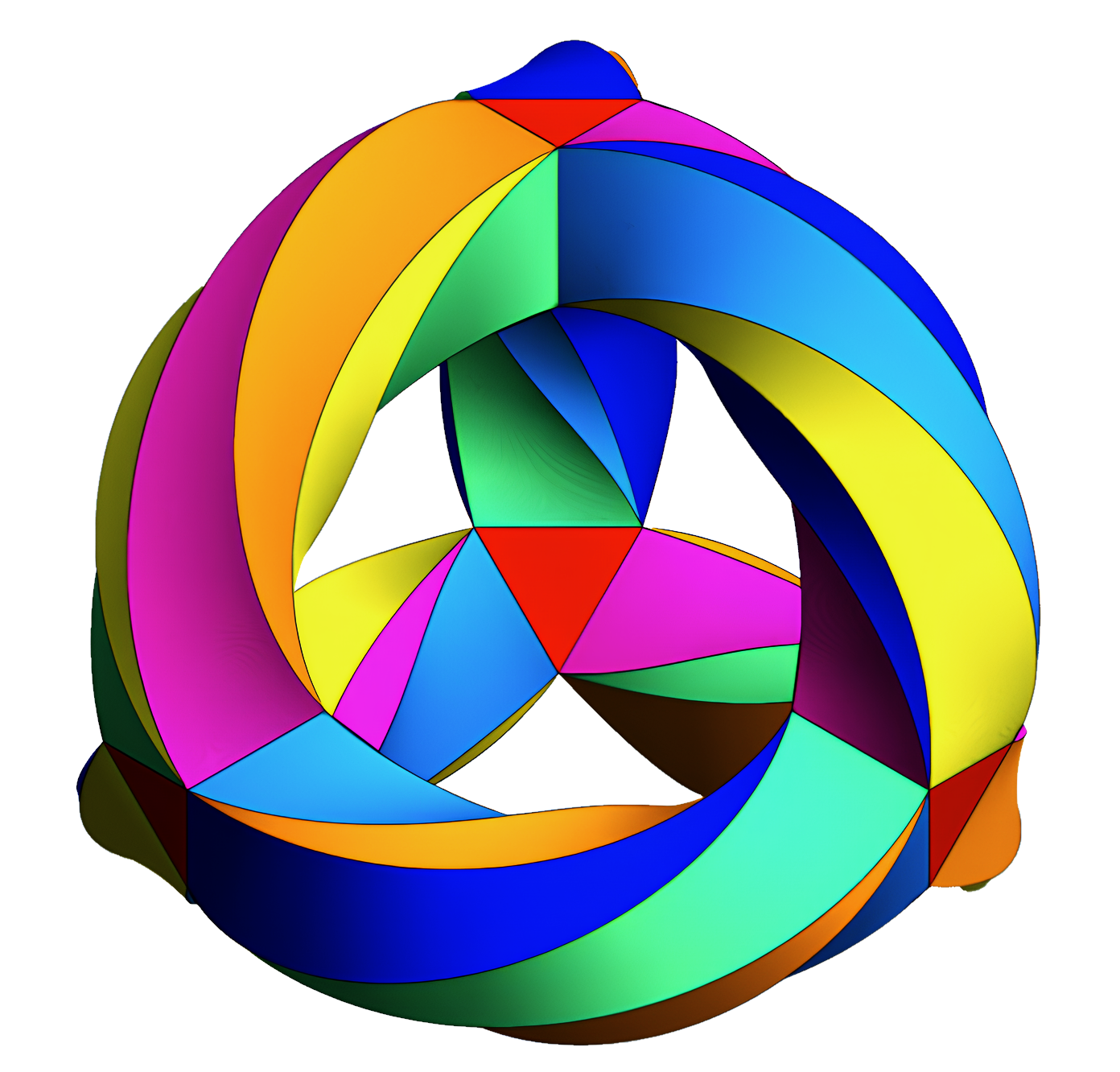
Let \(K\) be a compact Riemann surface of genus \(3\). From Hurwitz’s theorem, we know that a finite group acting holomorphically and effectively on \(K\) has its cardinal bounded by \(84(3-1)=168\). We will now show that this bound can actually be reached.
Consider the projective curve:
\[K=\{[X:Y:Z]\in\mathbb{CP}^2\mid X^3Y+ZY^3+XZ^3=0\}.\]This curve is known as the Klein quartic. Let us verify that \(K\) is indeed a compact Riemann surface.
Compactness and Smoothness
The compactness of \(K\) follows trivially, since it is defined in the projective space \(\mathbb{CP}^2\). To prove that \(K\) is smooth, it suffices to show that its defining equation describes a smooth algebraic curve in \(\mathbb P^2\). Smoothness is verified on each affine open set of \(\mathbb{CP}^2\). We proceed as follows:
- On \(U_X=\{[X:Y:Z]\mid X\ne0\}\): in this open set, the equation \(X^3Y+ZY^3+XZ^3=0\) transforms into:
\[z^3+zy^3+y=0,\]
where \(z=Z/X\) and \(y=Y/X\). Define \(f(z,y)=z^3+zy^3+y\). Its partial derivatives are:
\[\frac{\partial f}{\partial z}=3z^2+y^3,\qquad\frac{\partial f}{\partial y}=3zy^2+1.\]If \((z,y)\) satisfies both \(\partial f/\partial z=0\) and \(\partial f/\partial y=0\), then:
\[3zy^2+1=0\implies z=\frac{-1}{3y^2}.\]Substituting \(z\) back into the initial equation \(f(z,y)=0\), we get:
\[\frac{-1}{27y^6}-\frac y3+y=0\implies y^7=\frac1{18}.\]Furthermore, \(z^2=-y^3/3\), which would imply \(y^7=-1/3\), a contradiction. Hence, \(z^3+zy^3+y=0\) describes a smooth curve in \(\mathbb C^2\).
- Similar arguments hold for the charts \(U_Y\) and \(U_Z\), where similar substitutions lead to equivalent equations. Since no singular points exist in any open set, \(K\) is smooth globally.
Thus, \(K\) is a smooth, compact Riemann surface. Additionally, the irreducibility of the defining polynomial guarantees that \(K\) is connected.
Automorphism Group of \(K\)
We now show that the automorphism group \(G=\operatorname{Aut}(K)\) achieves the maximal possible order for \(g=3\), i.e., \(|G|=168=2^3\cdot3\cdot7\). Recall that \(\operatorname{Aut}(K)\) is finite since \(g(K)\geq2\). Below, we explicitly describe three automorphisms of \(K\) of orders \(2,3\), and \(7\), respectively:
1. An automorphism of order 2:
\[\tau=\frac{i}{\sqrt7}\begin{pmatrix}\omega-\omega^6&\omega^2-\omega^5&\omega^4-\omega^3\\\omega^2-\omega^5&\omega^4-\omega^3&\omega-\omega^6\\\omega^4-\omega^3&\omega-\omega^6&\omega^2-\omega^5\end{pmatrix},\]where \(\omega=e^{2i\pi/7}\) is a primitive 7th root of unity.
2. An automorphism of order 3:
\[\mu([x:y:z])=[z:x:y].\]3. An automorphism of order 7:
\[\gamma([x:y:z])=[\omega^4x:\omega^2y:\omega z].\]The group \(\langle\mu,\tau\rangle\) is isomorphic to \(S_3\) (the symmetric group of degree \(3\)), and \(\langle\gamma\rangle\cong\mathbb Z/7\mathbb Z\). The following relations hold:
\[\mu^{-1}\gamma\mu=\gamma^2,\qquad\tau^{-1}\mu\tau=\mu^2.\]These relations will be used in the proof of the following theorem.
The Simplicity and Order of \(G\)
Theorem 3.4.1. The group \(G=\operatorname{Aut}(K)\) is a simple group of order \(168\).
Proof. By Sylow’s theorem, we analyze the possible normal subgroups of \(G\).
- Suppose \(7\mid|H|\). If \(H\triangleleft G\) is normal, it must contain all 7-Sylow subgroups. Since \(n_7(G)>1\) and \(n_7(G)\equiv1\pmod7\), we have \(n_7(G)=8\), implying \(|H|\geq56\). Then \(G/H\cong\mathbb Z/3\mathbb Z\), contradicting the subgroup structure established earlier.
- Suppose \(3\mid|H|\). Using similar arguments, \(H\) must contain all 3-Sylow subgroups, and hence \(\mu\) must belong to \(H\). Furthermore, since \(\mu^{-1}\gamma\mu=\gamma^2\), it follows that \(\gamma\) would also lie in \(H\), contradicting the structure of \(G\).
- Finally, suppose \(2\mid|H|\). By Sylow’s theorem, this implies contradictions in the subgroup structure as well.
Since \(H\) cannot be nontrivial, \(G\) must be simple. Moreover, the fact that \(|G|\leq168\) forces \(|G|=168\), as this is the only value satisfying Hurwitz’s bound and Sylow’s constraints.
Remark
In the proof, we only used the automorphisms \(\tau\), \(\mu\), and \(\gamma\). It can be shown that \(\langle\tau,\mu,\gamma\rangle\) forms a simple group of order \(168\) and generates \(\operatorname{Aut}(K)\).
4. Appendix
4.1. Coverings and Riemann Surfaces
Let \(V\) be a real connected variety. The variety \(V\) satisfies all the assumptions of the classification theorem for connected coverings (arc-connected, locally arc-connected, and locally simply connected), which ensures that there is a one-to-one correspondence between the following two sets:
\[\left\{\begin{array}{c}\text{classes of isomorphisms}\\\text{of coverings }F:U\to V\end{array}\right\}\longleftrightarrow\left\{\begin{array}{c}\text{conjugacy classes of subgroups}\\H\subset\pi_1(V,q)\end{array}\right\}.\]Remark 4.1.1. As a reminder, the theorem applies only to CALCA coverings (arc-connected and locally arc-connected spaces). By the definition of \(V\), we can show that \(U\) is also CALCA. Indeed, taking a countable basis \((B_n)_{n\in\mathbb N}\) of \(V\), we can assume without loss of generality that each \(B_n\) is arc-connected and that
\[F^{-1}(B_n)=\bigsqcup_{i\in I_n}B_n^i,\]where each \(B_n^i\) is homeomorphic to \(B_n\) via \(F\). The family \(\{B_n^i,n\in\mathbb N,i\in I_n\}\) is thus a countable basis of arc-connected opens of \(U\). Analogously to showing that a connected variety is arc-connected, we deduce that \(U\) is arc-connected. Finally, we have shown that \(U\) naturally has the structure of a connected topological variety.
In the case where \(V\) is a Riemann surface, we have the following lemma:
Lemma 4.1.2. Let \(V\) be a Riemann surface and \(F:U\to V\) a connected covering. There exists a unique Riemann surface structure on \(U\) making \(F\) holomorphic.
Proof. We equip \(U\) with a Riemann surface structure making \(F\) holomorphic by defining the charts:
\[\phi\circ F|_O:O\to\mathbb C,\]where \(\phi\) is a coordinate chart on \(V\) and \(O\subset U\) is an open set such that \(F|_O:O\to F(O)\subset V\) is a homeomorphism. The compatibility of charts on \(U\) is induced by the compatibility of charts on \(V\).
We can easily check that \(U\) is separated, since \(F\) is a covering. Furthermore, \(U\) is both connected and countably based (from Remark 4.1.1). Thus, \(U\) satisfies the axioms of a Riemann surface.
For uniqueness, suppose that \((\psi_i,U_i)\) is an atlas on \(U\) making \(F\) holomorphic. Then \(\phi\circ F|_{U_i}\circ\psi_i^{-1}\) is holomorphic. This ensures the uniqueness of the complex structure defined above.
From the previous lemma, we deduce that if \(F_i:U_i\to V\) (\(i=1,2\)) are two coverings (where \(V\) is a Riemann surface) that belong to the same class of covering isomorphisms, then \(U_1\) and \(U_2\) are analytically isomorphic. This is because \(F_i\) will be a local biholomorphism via the respective induced complex structures.
4.2. Homology and Fundamental Group of the genus \(g\) torus \(T_g\)
For \(X\) a CW-complex, let’s denote \(C_*^{\mathrm{CW}}(X;R)\) the cell complex and \(C_*^{\mathrm{sing}}(X;R)\) the singular complex, with \(R\) any commutative ring. We will now compute the homology groups and the fundamental group of the \(g\)-hole torus \(T_g\). Reminder:
- \(C_n^{\mathrm{CW}}(X;R)=H_n^{\mathrm{sing}}(X^n,X^{n-1})\) (homology of \(X^{(n)}\) relative to \(X^{(n-1)}\)).
- Noting \(\partial_n:C_n^{\mathrm{sing}}(X;R)\) the edge application for singular homology, the edge application for cellular homology is defined as follows:
\[\begin{aligned}d_n:H_n^{\mathrm{sing}}(X^{(n)},X^{(n-1)})&\xrightarrow{\partial_n}H_{n-1}^{\mathrm{sing}}(X^{(n-1)};R)\\&\xrightarrow{(j_{n-1})_*}H_{n-1}^{\mathrm{sing}}(X^{(n-1)},X^{(n-2)}),\end{aligned}\]
with \(j_n:X^{(n)}\longrightarrow(X^{(n)},X^{(n-1)})\) the canonical inclusion.
- \(\forall n\in\mathbb N,\ H_n^{\mathrm{CW}}(X;R)\cong H_n^{\mathrm{sing}}(X;R)\).
- \(C_n^{\mathrm{CW}}(X;R)\) is a free \(R\)-module of basis \((e_\alpha^n)_{\alpha\in A_p}\), the family of \(n\)-open \(n\)-dimensional cells of \(X\).
(1) Cellular Homology of \(T_g\)
We can represent \(T_g\) using a \(4g\)-gon as shown in the following image, constructed by the successive attachment of handles, each represented by a square.
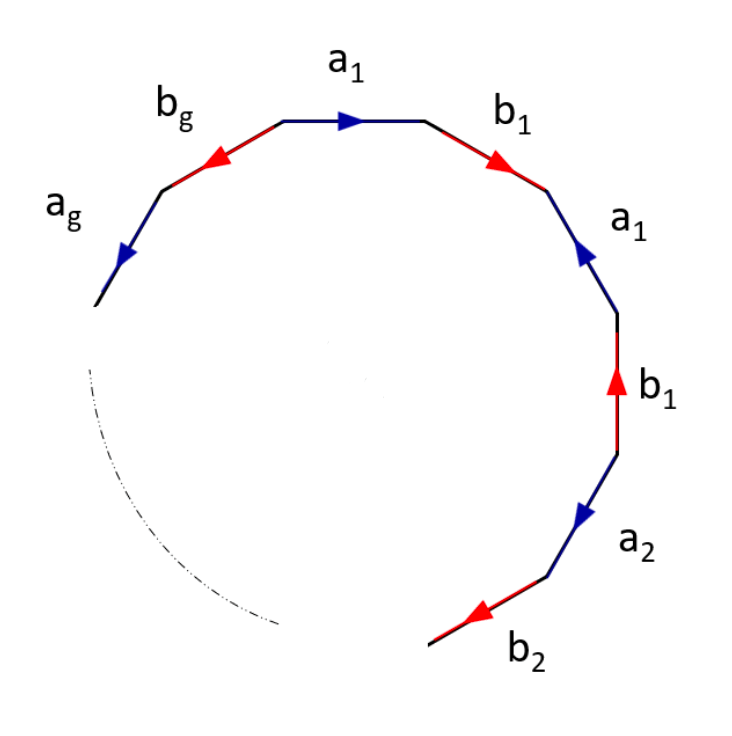
\(T_g\) is therefore naturally equipped with a CW-complex structure: a single \(0\)-cell \(e^0\), corresponding to all the vertices of the polygon; \(2g\) \(1\)-cells corresponding to the edges \(a_1,b_1,\ldots,a_g,b_g\); a single \(2\)-cell \(e^2\), corresponding to the interior of the polygon.
Using the properties of CW complex homology, the cellular chain groups are:
\[C_n^{\mathrm{CW}}(T_g;R)=\begin{cases}R,&\text{if }n=0,2,\\\displaystyle\bigoplus_{i=1}^{2g}R,&\text{if }n=1,\\0,&\text{if }n\geq3.\end{cases}\]Since \(T_g\) is arc-connected, we have:
\[H_0^{\mathrm{sing}}(T_g;R)\cong H_0^{\mathrm{CW}}(T_g;R)=C_0^{\mathrm{CW}}(T_g;R)/\operatorname{im}(d_1)=R/\operatorname{im}(d_1).\]It follows that \(d_1=0\), and therefore \(\ker(d_1)=C_1^{\mathrm{CW}}(T_g;R)\). Now for \(d_2\), since \(C_2^{\mathrm{CW}}(T_g;R)\) is generated by the \(2\)-cell \(e^2\), we calculate the image of \(e^2\). Triangulating \(e^2\) correctly, as a union of \(2\)-simplices, and taking into account the orientation of the edges:
\[\partial_2(e^2)=0,\]which implies that \(d_2=0\).
Finally, the homology groups of \(T_g\) are:
\[H_n^{\mathrm{CW}}(T_g;R)=\begin{cases}R,&\text{if }n=0,2,\\\displaystyle\bigoplus_{i=1}^{2g}R,&\text{if }n=1,\\0,&\text{otherwise}.\end{cases}\](2) Fundamental Group of \(T_g\)
Here, let us calculate the fundamental group of \(T_g\) for the case \(g=2\). The general case is analogous. To start, recall van Kampen’s theorem:
Theorem 4.2.1 (van Kampen’s theorem). Let \(X=U\cup V\) be a topological space, expressed as the union of two arc-connected open sets \(U\) and \(V\), where \(U\cap V\) is also arc-connected. Then for any \(z\in U\cap V\):
- The natural morphism \(\pi_1(U,z)*\pi_1(V,z)\to\pi_1(X,z)\) is surjective.
- The kernel of the above morphism is the distinguished subgroup \(N\) generated by elements \(i_1(w)i_2(w)^{-1}\) of the free product, for all \(w\in\pi_1(U\cap V,z)\), where \(i_1\) and \(i_2\) are the canonical inclusions of \(\pi_1(U,z)\) and \(\pi_1(V,z)\) into \(\pi_1(X,z)\). Thus: \[\pi_1(X,z)\cong\frac{\pi_1(U,z)*\pi_1(V,z)}{N}.\]
Let us consider \(U\) and \(V\) as shown in the following illustration:
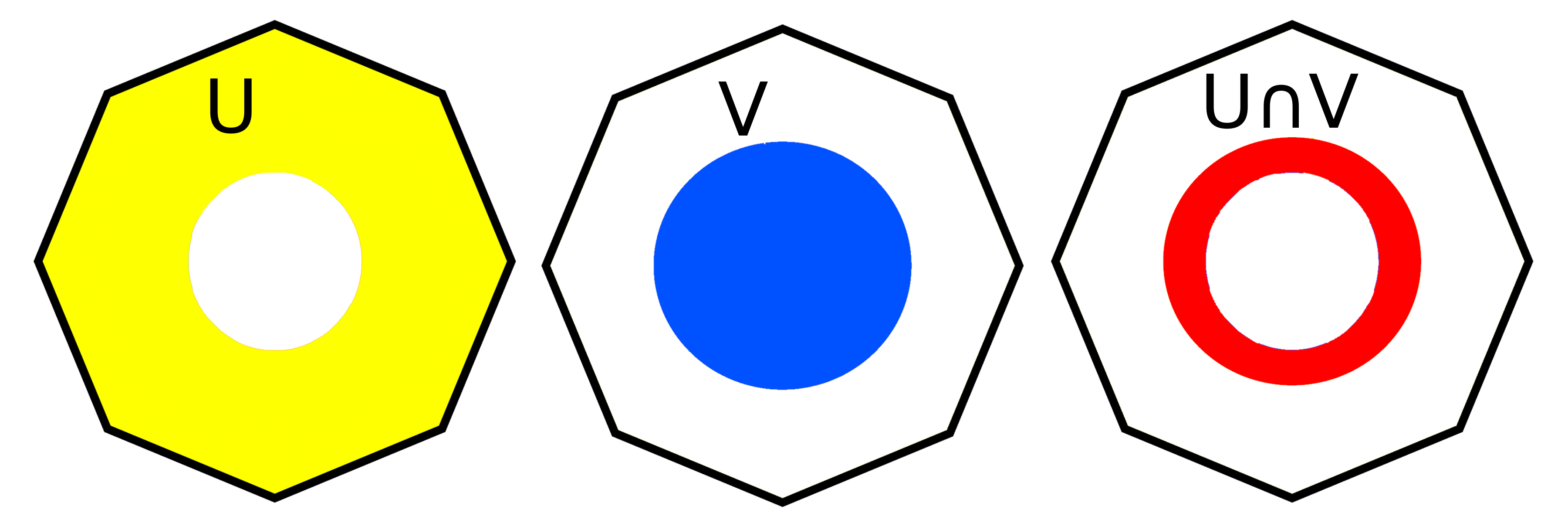
Let \(w\in\pi_1(U\cap V,z)\). The open set \(U\) retracts to the boundary loop of the \(4\)-gon, so \(U\) is homotopically equivalent to the wedge sum of \(4\) circles. Thus, \(w\) is homotopic in \(U\) to:
\[a_1b_1a_1^{-1}b_1^{-1}a_2b_2a_2^{-1}b_2^{-1}.\]The open set \(V\) is contractible, so the loop \(w\) is trivial in \(V\). Finally, the intersection \(U\cap V\) is homotopically equivalent to \(S^1\), so \(\pi_1(U\cap V,z)=\mathbb Z\). It follows that:
\[\pi_1(T_2,z)\cong\langle a_1,b_1,a_2,b_2\mid a_1b_1a_1^{-1}b_1^{-1}a_2b_2a_2^{-1}b_2^{-1}=1\rangle.\]Generalizing to \(g\geq2\), the fundamental group of \(T_g\) is:
\[\pi_1(T_g)\cong\left\langle a_1,b_1,\ldots,a_g,b_g\ \middle|\ \prod_{i=1}^{g}[a_i,b_i]=1\right\rangle.\]4.3. Proof of the Relation \(\mu(\Lambda)=|\Gamma:\Lambda|\mu(\Gamma)\)
Let us prove that the measure \(\mu\), which computes the hyperbolic area of a subset \(A\subset\mathbb H\), is invariant under the action of \(\operatorname{PSL}(2,\mathbb R)\).
Let \(A\subset\mathbb H\) (assumed measurable) and \(T=\begin{pmatrix}a&b\\c&d\end{pmatrix}\in\operatorname{PSL}(2,\mathbb R)\). Writing \(z=x+iy\) and \(T(z)=\frac{az+b}{cz+d}=u(x,y)+iv(x,y)\), we know from the Cauchy–Riemann equations that:
\[\det(dT(x,y))=\partial_xu\cdot\partial_yv-\partial_yu\cdot\partial_xv=(\partial_xu)^2+(\partial_xv)^2=\frac1{|cz+d|^4}.\]Moreover, since \(v=\frac y{|cz+d|^2}\), we calculate:
\[\mu(T(A))=\int_{T(A)}\frac{du\,dv}{v^2}=\int_A\frac{|cz+d|^4}{y^2}\det(dT(x,y))\,dx\,dy=\mu(A).\]Thus, the measure \(\mu\) is invariant under the action of \(\operatorname{PSL}(2,\mathbb R)\).
Now, consider a fundamental domain \(F_\Gamma\) of \(\Gamma\). Let \(\{T_i\}_{i\in I\subset\mathbb N}\) be a right coset decomposition of \(\Gamma\) with respect to \(\Lambda\). We claim that the set:
\[F_\Lambda=\bigcup_{i\in\mathbb N}T_i(F_\Gamma)\]is a fundamental domain for \(\Lambda\). This will allow us to conclude, as we will then have:
\[\mu(\Lambda)=\sum_{i\in I}\mu(T_i(F_\Gamma))=\sum_{i\in I}\mu(F_\Gamma)=|\Gamma:\Lambda|\mu(\Gamma).\]- It is easy to check that \(\overline{\mathring F_\Lambda}=F_\Lambda\).
- \(\mathbb H=\bigcup_{S\in\Lambda}S(F_\Lambda)\): For any \(z\in\mathbb H\), there exist \(y\in F_\Gamma\) and \(T\in\Gamma\) such that \(z=T(y)\). There also exists \(i\in\mathbb N\) such that \(T\in\Lambda T_i\), so there exists \(S\in\Lambda\) such that \(z=S(w)\) with \(w=T_i(y)\in F_\Lambda\).
- \(\mathring F_\Lambda\cap S(\mathring F_\Lambda)=\varnothing\) for all \(S\ne\mathrm{id}\): If there were \(z=S(y)\) such that \(z\in\mathring F_\Lambda\cap S(\mathring F_\Lambda)\) for some \(S\ne\mathrm{id}\), then there would exist \(i,j\in\mathbb N\) such that \(z,y\in T_i(F_\Gamma)\cap T_j(F_\Gamma)\). By the disjointness property of \(F_\Gamma\), \(T_i=ST_j\), but since \(T_i\) and \(T_j\) are distinct coset representatives, \(i=j\), which leads to a contradiction.
References
- [Mira] R. Miranda, Algebraic Curves and Riemann Surfaces, American Mathematical Society, 1995.
- [Dolg] I. Dolgachev, Topics in Classical Algebraic Geometry, Part I, 2014.
- [Faul] Eivind Fauli, Thesis on Knot Theory, 2021.
- [Berg] N. Begeron, A. Guilloux, Introduction to Riemann surfaces.
- [Nima] N. Anvari, Automorphisms of Riemann surfaces, August 2009.
- [Cejk] N. Cejka, Jørgensen Lemma, 2016.
- [Favr] Charles Favre, Riemann surfaces and theory of coverings.
- [Live] M. Livernet, Algebraic topology, ENS Paris course.
- [Rydh] J. Rydholm, Classification of Compact Orientable Surfaces using Morse Theory, August 2016.
- [Fark] H. M. Farkas, I. Kra, Riemann Surfaces (second edition).
- [Thom] Carsten Thomassen, The Jordan–Schönflies Theorem and the Classification of Surfaces, 1992.
- [Fisc] G. Fischer, Plane Algebraic Curves, American Mathematical Society, 1994.
- [Kato] S. Katok, Fuchsian Groups, 1992.
- [Unif] Henri Paul de Saint-Gervais, Uniformization of Riemann surfaces.
- [Tele] C. Teleman, Riemann Surfaces, 2003.
- [Scha] Paul Schmutz Schaller, Geometric characterization of hyperelliptic Riemann surfaces.
- [Bobe] Alexander I. Bobenko, Introduction to Compact Riemann Surfaces.
- [Macb] A. M. Macbeath, On a theorem of Hurwitz, 1960.
- [Bolz] O. Bolza, On Binary Sextics with Linear Transformations into Themselves.
- [Kuus] T. Kuusalo, M. Näätänen, Geometric uniformization in genus 2, 1995.
- [Brou] S. Allen Broughton, Classifying finite group actions on surfaces of low genus, 1990.
Transcription notes
The mathematical text, proofs, examples and bibliography above reproduce the manuscript. The appendix figures come from the same document and have been extracted from the pages to remain legible on screen. The reference “Corollary ??” at the start of Section 3.1 has been resolved as “Corollary 2.2.4”. Several statements in the source version require the following clarifications.
In Corollary 2.1.3, cyclicity also uses the faithfulness assumption in Proposition 2.1.1. The proof of Theorem 2.4.7 uses the setting of a universal covering, where the group \(K\) acts freely. In the proof of Theorem 2.4.4, \(\mathbb C^*\) is not simply connected and therefore is not one of the three universal covering surfaces \(\mathbb C,\mathbb H,\mathbb P^1(\mathbb C)\).
The area ratio at the end of the finiteness proof on p. 31 is inverted: the appendix relation gives \([N(K):K]=\mu(K)/\mu(N(K))\). In the proof of Lemma 2.2.5(c), for \(k=4\), the useful lower bound is \(R\geq4-3/2-1/3=13/6>2+1/42\). For the dihedral action in Section 3.1, \((\alpha\beta)(z)=e^{2\pi i/r}/z\), so the fixed points satisfy \(z^2=e^{2\pi i/r}\).
In Section 3.2, it is the lattices \(\Lambda_i\) that are discrete, rather than the tori \(\mathbb C/\Lambda_i\). In case (5) of Section 3.3, the map \((x,y)\mapsto(-x,y)\) given in the manuscript does not preserve the displayed equation, whose right-hand side is an odd polynomial; this example requires correction before it can be used as a generator. These clarifications distinguish the source transcription from a complete mathematical revision of the manuscript.